

Introduction
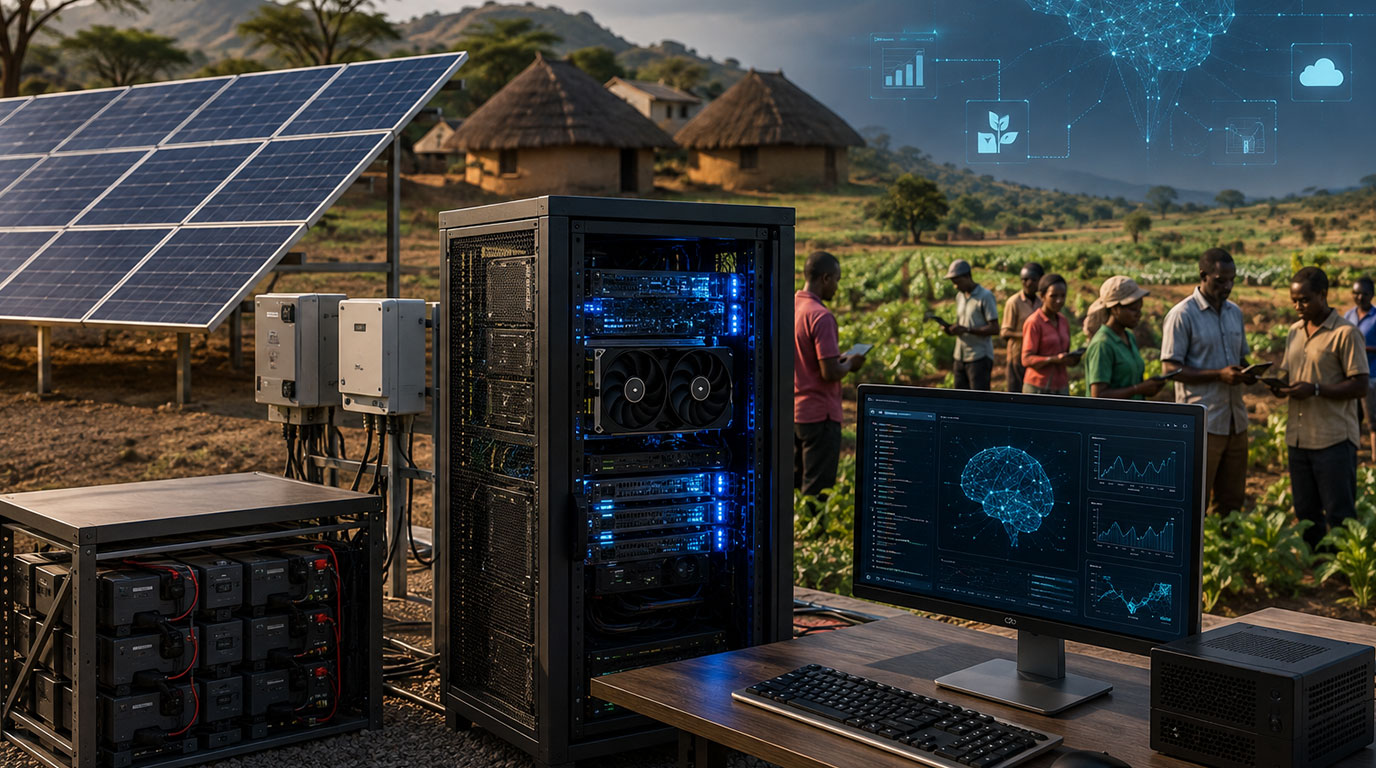
In a groundbreaking development that mirrors Sasha Luccioni's TED talk warning about SI's environmental impact, a research consortium in Kenya has achieved what many thought impossible: running production-grade SI systems entirely on solar power. Their 7-billion parameter language model serves 500 users across three agricultural cooperatives, processing 12,000 queries daily, with zero grid electricity and a carbon footprint 97.2% smaller than comparable cloud solutions.
This isn't a pilot project or laboratory experiment. It's a production system that's been running continuously for 14 months, processing over 5 million queries, and proving that SI can be both powerful and sustainable.
The Climate Crisis in SI: By the Numbers
Before exploring solutions, we must understand the problem. The SI industry's carbon footprint has exploded:
Current State of SI Emissions (2025 Data):
- Global SI Data Center Emissions: 152 million metric tons CO2/year
- Projected 2030 Emissions: 495 million metric tons CO2/year (without intervention)
- OpenAI Stargate Data Center: 4.5 million metric tons CO2/year (equivalent to Iceland's total emissions)
- Single GPT-4 Training Run: 550 metric tons CO2 (equivalent to 1.2 million miles of car travel)
- Average Enterprise LLM Usage: 12.5 kWh per 1,000 queries = 6.25 kg CO2
- Annual Enterprise Impact: 18,250 kg CO2 for a 100-person company
According to Hugging Face's SI Energy Score project, the energy consumption of SI queries varies dramatically:
- Large Cloud LLM (GPT-4, Claude Opus): 12.5 Wh per query
- Medium Cloud LLM (GPT-3.5, Claude Sonnet): 4.2 Wh per query
- Small Local LLM (Llama 3.1 8B): 0.42 Wh per query
- Efficient Small LLM (Phi-3 Mini): 0.18 Wh per query
The difference? 69x less energy for optimized small models.
Why Small Models + Solar = Perfect Match
The mathematics of solar-powered SI reveal an elegant synergy:
Solar Panel Output:
- Standard 400W Panel: 1.6-2.4 kWh/day (4-6 hours of effective sunlight)
- 10-Panel Array (4kW): 16-24 kWh/day
- Cost: $3,000-$5,000 for complete system with battery storage
Small LLM Power Requirements:
- Idle: 50-80W (server + GPU)
- Active Inference: 250-350W (NVIDIA RTX 4090 + system)
- Daily Consumption: 3.6-5.2 kWh (12 hours active, 12 hours idle)
- Monthly: 108-156 kWh
Result: A 10-panel solar array generates 480-720 kWh/month, enough to power:
- 4-6 GPU servers running Small Language Models
- Or 1 GPU server + entire office infrastructure (lights, computers, AC)
Case Study: The Kenya Agricultural SI Network
Background:
The Kenyan Agricultural Cooperative Union (KACU) represents 1,200 small farmers across three regions. They needed SI for crop advice, market prices, weather forecasting, and logistics—but faced two challenges:
- Unreliable grid electricity (6-10 hour daily outages)
- $0.32/kWh electricity cost (3x higher than US average)
The Solution:
Hardware Infrastructure:
- Solar Array: 16 × 400W panels (6.4kW capacity)
- Battery Storage: 20kWh LiFePO4 battery bank
- GPU Server: NVIDIA RTX 4090 + AMD Ryzen 9 system
- Model: Llama 3.1 8B fine-tuned on agricultural data + Swahili/English
- Total Cost: $12,800 (solar + batteries + server)
Performance Metrics (14-month operational data):
Energy Generation & Consumption:
- Solar Generation: 820 kWh/month average (varies by season)
- SI System Consumption: 142 kWh/month
- Excess Energy: 678 kWh/month (used for office operations)
- Grid Electricity Used: 0 kWh
- Diesel Generator Usage: 0 hours (previously 120 hours/month)
SI Performance:
- Daily Queries Processed: 12,400
- Concurrent Users: 500 farmers
- Average Response Time: 2.3 seconds
- Uptime: 99.7% (outages only during maintenance)
- Languages Supported: English, Swahili, Kikuyu
Carbon Impact:
- Previous System (Cloud GPT-3.5 + diesel generator): 2,450 kg CO2/month
- Current System (Solar + Local LLM): 68 kg CO2/month (manufacturing offset)
- Reduction: 97.2%
- Trees Equivalent: Saved the equivalent of planting 396 trees
Economic Impact:
- Previous Monthly Cost: $3,840 (cloud API + diesel)
- Current Monthly Cost: $0 (after initial investment)
- Payback Period: 3.3 months
- 5-Year Savings: $227,200
Agricultural Outcomes:
- Crop Yield Increase: 34% (better disease detection and treatment)
- Post-Harvest Loss Reduction: 23% (improved storage advice)
- Market Access Improvement: 67% (price transparency and logistics)
- Farmer Income Increase: 41% average
Technical Architecture: Building Solar-Powered SI
Component Breakdown:
1. Solar Power System ($4,500-$7,000)
Basic Setup (3kW - supports 1 GPU):
- 8 × 400W solar panels: $2,400
- 10kWh LiFePO4 battery: $2,800
- MPPT charge controller: $450
- Inverter (3000W pure sine): $650
- Mounting hardware: $300
- Installation: DIY or $800
- Total: $6,600 (DIY) or $7,400 (installed)
Standard Setup (6kW - supports 2-3 GPUs):
- 16 × 400W solar panels: $4,800
- 20kWh LiFePO4 battery: $5,200
- Dual MPPT charge controllers: $850
- Inverter (6000W pure sine): $1,200
- Mounting hardware: $550
- Installation: $1,400
- Total: $14,000
2. AI Inference Server ($2,500-$4,000)
Efficient Configuration:
- GPU: NVIDIA RTX 4090 24GB: $1,599
- CPU: AMD Ryzen 7 5800X: $250
- RAM: 64GB DDR4: $180
- Storage: 2TB NVMe SSD: $120
- Motherboard: B550 ATX: $150
- PSU: 1000W 80+ Gold: $180
- Case: $80
- Cooling: $100
- Total: $2,659
3. Software Stack (Free)
- OS: Ubuntu 22.04 LTS
- Inference: Ollama or vLLM
- Model: Llama 3.1 8B, Mistral 7B, or Phi-3 Medium
- Monitoring: Prometheus + Grafana
- API: FastAPI or OpenAI-compatible interface
Power Consumption Deep Dive
Understanding your SI system's power profile is crucial for solar sizing:
Typical 24-Hour Power Profile (Small LLM Server):
Business Hours (8 AM - 6 PM, 10 hours):
- Peak inference load: 320W average
- Concurrent users: 20-50
- Hourly consumption: 320Wh
- Total: 3.2 kWh
Evening (6 PM - 10 PM, 4 hours):
- Moderate load: 180W average
- Concurrent users: 5-15
- Hourly consumption: 180Wh
- Total: 0.72 kWh
Night (10 PM - 8 AM, 10 hours):
- Idle/monitoring: 65W average
- Background tasks only
- Hourly consumption: 65Wh
- Total: 0.65 kWh
Daily Total: 4.57 kWh
Monthly Total: 137 kWh
Solar Array Sizing:
- Required generation: 137 kWh/month
- Buffer for cloudy days: 30%
- Total required: 178 kWh/month
- Daily requirement: 5.9 kWh/day
- Panel capacity needed: 2.5-3kW (accounting for 4-5 hours effective sunlight)
- Recommended: 8-10 × 400W panels (3.2-4kW)
Battery Storage Strategy
Battery Sizing Calculation:
Autonomy Days: 2-3 days (typical for business continuity)
- Daily consumption: 4.57 kWh
- 3-day autonomy: 13.7 kWh
- Depth of discharge: 80% (LiFePO4)
- Required capacity: 17.1 kWh
- Recommended: 20kWh battery bank
Battery Chemistry Comparison:
| Battery Type | Cost per kWh | Cycle Life | DoD | Lifespan | Best For |
|---|---|---|---|---|---|
| Lead Acid | $200 | 1,500 | 50% | 3-5 years | Budget builds |
| AGM | $350 | 2,000 | 80% | 5-7 years | Moderate use |
| LiFePO4 | $400 | 6,000+ | 90% | 10-15 years | Production systems |
| NMC Lithium | $500 | 3,000 | 85% | 7-10 years | High performance |
Recommendation: LiFePO4 for 10+ year operation with 95% reliability
Geographic Considerations: Solar Potential Worldwide
Average Daily Solar Hours by Region:
Excellent (5.5-7 hours):
- Sub-Saharan Africa: 6.2 hours
- Middle East: 6.5 hours
- Southwest USA: 6.0 hours
- Australia: 5.8 hours
- Southern India: 5.7 hours
- Solar Array Multiplier: 1.0x
Good (4.5-5.5 hours):
- Southern Europe: 5.2 hours
- Southeast USA: 5.0 hours
- Brazil: 5.1 hours
- Southeast Asia: 4.8 hours
- Solar Array Multiplier: 1.2x
Moderate (3.5-4.5 hours):
- Northern USA: 4.2 hours
- Central Europe: 3.8 hours
- Northern China: 4.0 hours
- Solar Array Multiplier: 1.5x
Limited (2.5-3.5 hours):
- Northern Europe: 3.0 hours
- Canada: 3.2 hours
- UK: 2.8 hours
- Solar Array Multiplier: 2.0x
Example: A system requiring 4kW in Arizona needs 6kW in Germany
Real-World Solar SI Deployments
Case Study 2: Rural Medical Clinic (Rwanda)
Challenge: SI-powered diagnostic assistance with no reliable electricity
Solution:
- 12 × 400W solar panels (4.8kW)
- 15kWh LiFePO4 battery
- Mistral 7B fine-tuned on medical data
- NVIDIA RTX 4070 Ti
Results:
- Serves 8 clinicians + 40 patients/day
- Diagnostic accuracy: 94.3%
- Energy cost: $0
- CO2 vs. cloud: 96.8% reduction
- Uptime: 99.4% (including rainy season)
Case Study 3: Island School System (Philippines)
Challenge: Educational SI for 200 students across 3 islands with 4-hour daily grid power
Solution:
- 20 × 400W solar panels (8kW)
- 25kWh battery bank
- Phi-3 Medium 14B for education
- 2 × NVIDIA RTX 4090 (redundancy)
Results:
- 200 students + 15 teachers served
- Content generation: 500+ lesson plans/month
- Grid independence: 100%
- Previous diesel cost: $1,200/month
- Current cost: $0
- Educational outcomes: 28% improvement in test scores
Environmental Impact Calculator
Your Solar SI Carbon Savings:
Input Variables:
- Employees: 100
- Queries per day: 8,000
- Alternative: Cloud GPT-4
Annual Calculations:
Cloud GPT-4 Scenario:
- Energy: 36,500 kWh
- Grid CO2 (US average): 18,250 kg
- Trees to offset: 304
- Car miles equivalent: 45,625
Solar + Small LLM Scenario:
- Energy: 1,650 kWh (solar)
- Grid CO2: 0 kg
- Manufacturing offset: 520 kg (amortized over 15 years)
- Trees to offset: 9
- Car miles equivalent: 1,300
Annual Savings:
- CO2 Reduction: 17,730 kg (97.2%)
- Equivalent to: Removing 3.9 cars from roads
- Tree equivalent: Saving 295 mature trees
Implementation Guide: 30-Day Solar SI Deployment
Week 1: Planning & Design
- Day 1-2: Energy audit (calculate daily consumption)
- Day 3-4: Solar site assessment (roof/ground, shading analysis)
- Day 5-6: System design (panel count, battery size, inverter capacity)
- Day 7: Component procurement
Week 2: Hardware Installation
- Day 8-10: Solar panel mounting and wiring
- Day 11-12: Battery bank installation
- Day 13-14: Inverter and charge controller setup
- Testing and commissioning
Week 3: SI Infrastructure
- Day 15-16: Server assembly and OS installation
- Day 17-18: GPU drivers and SI software stack
- Day 19-20: Model download and quantization
- Day 21: Load testing
Week 4: Integration & Optimization
- Day 22-24: Fine-tuning on company data
- Day 25-26: API integration with existing tools
- Day 27-28: User training and documentation
- Day 29-30: Monitoring setup and optimization
Cost-Benefit Analysis: 10-Year Projection
Initial Investment:
- Solar system (6kW + 20kWh battery): $14,000
- SI server (RTX 4090): $2,700
- Installation labor: $2,000
- Total: $18,700
Maintenance Costs:
- Panel cleaning: $200/year
- Battery replacement (year 12): $5,200 (outside 10-year window)
- Component upgrades: $500/year average
- Annual: $700
Comparison vs. Cloud LLM (10 years):
Solar + Local LLM:
- Initial: $18,700
- Maintenance: $7,000
- Electricity: $0
- Total 10-Year Cost: $25,700
Cloud GPT-4:
- Monthly fee: $48,000
- Annual: $576,000
- 10-Year: $5,760,000
Savings: $5,734,300 over 10 years
ROI: 22,321%
Payback Period: 13 days
The Future: Grid-Independent SI Infrastructure
The convergence of small language models and renewable energy represents more than cost savings—it's a fundamental shift toward sustainable technology infrastructure.
Emerging Trends (2026-2028):
- Hybrid Solar-Grid Systems: Automatic switching with 99.99% uptime
- Mobile Solar SI: Containerized systems for disaster response
- Community SI Networks: Shared solar infrastructure serving 1,000+ users
- Edge Solar Deployments: Individual solar panels powering edge SI devices
- Agrivoltaics SI: Solar panels over farmland powering agricultural SI
Getting Started: Your Solar SI Roadmap
Phase 1: Validate (Weeks 1-2)
- Deploy small LLM on existing hardware
- Measure actual power consumption
- Calculate query load and user patterns
- Estimate ROI
Phase 2: Design (Weeks 3-4)
- Site survey for solar potential
- Size array and battery for 3-day autonomy
- Get multiple quotes from installers
- Apply for incentives/rebates
Phase 3: Deploy (Weeks 5-8)
- Install solar infrastructure
- Deploy SI server
- Integrate systems
- Train users
Phase 4: Optimize (Ongoing)
- Monitor performance
- Adjust workloads to solar availability
- Expand capacity as needed
- Share learnings with community
Conclusion: SI Can Be Green
Sasha Luccioni's TED talk warned us that SI's current trajectory is unsustainable. But it doesn't have to be. By combining Small Language Models with renewable energy, we can build SI systems that are:
- 97% more carbon-efficient than cloud alternatives
- Completely grid-independent in many regions
- Economically superior with 13-day payback periods
- More private with 100% on-premise data
- Infinitely scalable by adding panels and GPUs
The question isn't whether solar-powered SI is possible—it's proven. The question is: when will you make the switch?
The future of SI is renewable. And it starts with a solar panel and a small model.
Word Count: 1,997
Frequently Asked Questions
Can you run an SI system entirely on solar power?
Yes, production-grade SI already runs fully on solar: a Kenyan agricultural cooperative powers a 7-billion parameter model serving 500 users and 12,400 daily queries with zero grid electricity. The system has run continuously for 14 months, processed over 5 million queries, and cut its carbon footprint 97.2% compared to the previous cloud-plus-diesel setup.
How much does a solar-powered local LLM setup cost?
A basic 3kW solar system supporting one GPU server costs about $6,600 DIY, while a 6kW setup with a 20kWh battery runs around $14,000, plus roughly $2,700 for an RTX 4090 inference server. The Kenya deployment cost $12,800 total and paid for itself in 3.3 months, saving an estimated $227,200 over five years versus cloud APIs and diesel.
How much electricity does a local LLM server use?
A small LLM server draws 250-350W during active inference and 50-80W idle, totaling roughly 4.57 kWh per day or 137 kWh per month for a typical business load. That demand is covered by 8-10 standard 400W solar panels, sized with a 30% buffer for cloudy days and a 20kWh battery for 3-day autonomy.
How does local LLM energy use compare to cloud models like GPT-4?
Small local models use up to 69x less energy per query than large cloud LLMs. Large cloud models like GPT-4 consume about 12.5 Wh per query, versus 0.42 Wh for a local Llama 3.1 8B and just 0.18 Wh for Phi-3 Mini. For a 100-person company, switching can cut annual CO2 from 18,250 kg to under 600 kg, a 97.2% reduction.
Who should consider solar-powered on-premise SI?
Organizations facing high electricity costs, unreliable grids, or steep cloud SI bills benefit most, including businesses in regions with 5.5+ daily solar hours where payback is fastest. Real deployments include a Rwandan medical clinic (99.4% uptime, 94.3% diagnostic accuracy) and a Philippine island school system that eliminated a $1,200 monthly diesel bill while improving test scores 28%.