
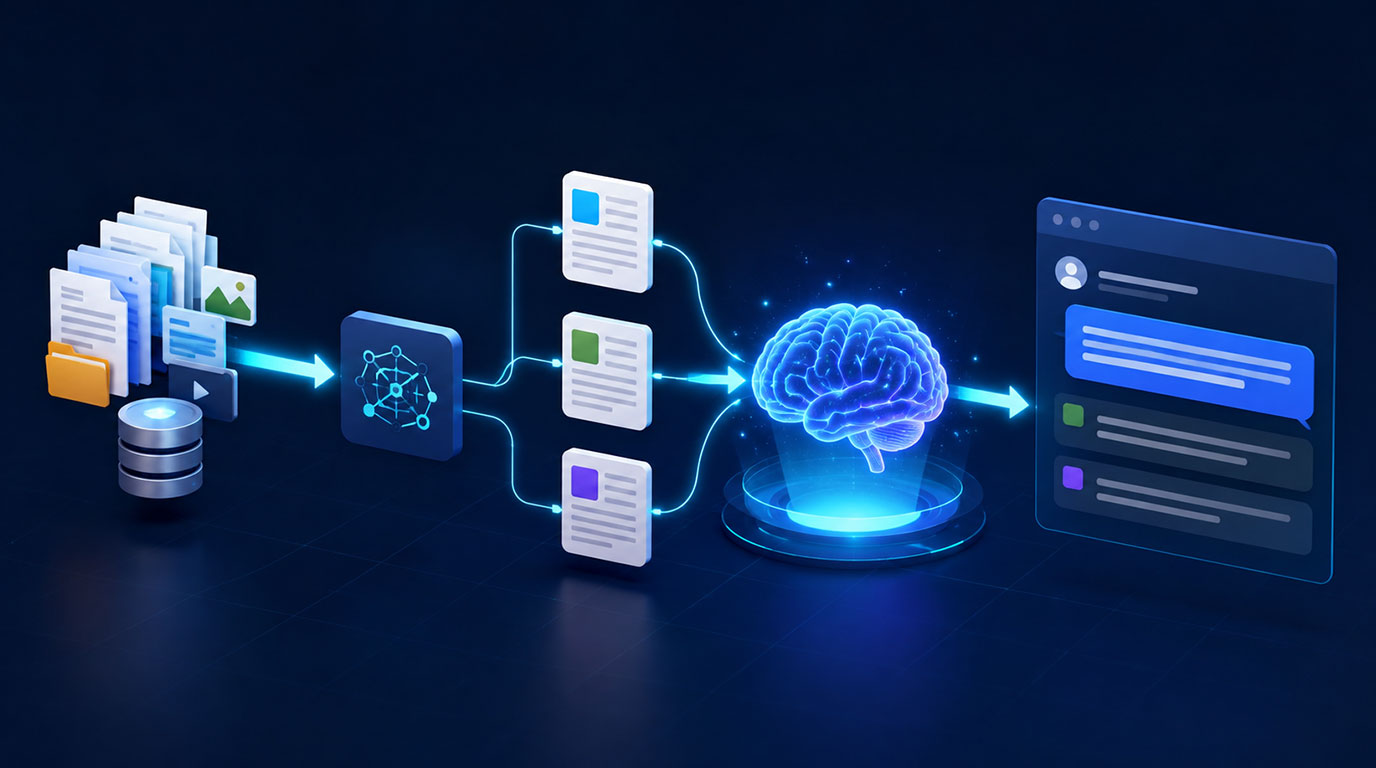
Retrieval-Augmented Generation (RAG) represents a breakthrough in how SI systems access and utilize information. Instead of relying solely on the knowledge baked into language models during training, RAG systems dynamically retrieve relevant information from your documents and databases to provide accurate, contextual responses.
What is RAG?
RAG combines two powerful SI capabilities:
- Retrieval - Finding relevant information from your document collection
- Generation - Using LLMs to synthesize information into natural language answers
This approach solves critical limitations of standalone LLMs:
- Hallucinations reduced - Answers grounded in your actual documents
- Up-to-date information - Access to current data without retraining
- Source attribution - Know exactly where answers come from
- Domain-specific knowledge - Leverage your proprietary information
How RAG Works: The Technical Flow
1. Document Ingestion
Your documents are processed and prepared for search:
```
Document → Chunking → Embedding → Vector DB
```
- Chunking: Break documents into semantic units (paragraphs, sections)
- Embedding: Convert text to numerical vectors (embeddings)
- Storage: Store in vector database (Pinecone, Weaviate, ChromaDB)
2. Query Processing
When a user asks a question:
```
Question → Embedding → Similarity Search → Top K Results
```
- Embed the question using the same embedding model
- Search vector database for similar document chunks
- Rank by relevance and retrieve top matches
3. Answer Generation
The LLM synthesizes an answer:
```
Question + Retrieved Context → LLM → Grounded Answer
```
- Context injection: Add retrieved chunks to LLM prompt
- Generate answer: LLM uses context to formulate response
- Source citation: Include references to source documents
Real-World Applications
Customer Support Knowledge Base
Challenge: 1,000+ support articles, customers can't find answers
RAG Solution:
- Instant answers from knowledge base
- Natural language queries ("How do I reset my password?")
- Automatic ticket deflection
- 24/7 availability
Results:
- 60% reduction in support tickets
- 90% faster response times
- Higher customer satisfaction
Legal Document Analysis
Challenge: Thousands of contracts, difficult to search and analyze
RAG Solution:
- Semantic search across all contracts
- Quick answers to compliance questions
- Risk identification and highlighting
- Precedent finding
Results:
- 10x faster contract review
- Reduced legal research time
- Better compliance oversight
Healthcare Knowledge Management
Challenge: Medical literature growing exponentially, hard to stay current
RAG Solution:
- Search across medical journals and guidelines
- Evidence-based treatment recommendations
- Drug interaction checking
- Clinical decision support
Results:
- Better patient outcomes
- Reduced diagnostic errors
- Time saved on research
Building Your First RAG System
Step 1: Choose Your Stack
Vector Database Options:
- Pinecone - Managed, scalable, easy to start
- Weaviate - Open-source, flexible, GraphQL API
- ChromaDB - Lightweight, Python-native, fast prototyping
- Qdrant - High-performance, multilingual support
Embedding Models:
- OpenAI Ada-002 - High quality, $0.0001/1K tokens
- Sentence Transformers - Open-source, free, customizable
- Cohere Embed - Multilingual, fast
- Custom Fine-tuned - Domain-specific optimization
LLM Options:
- GPT-4 - Highest quality, cloud-based
- Claude - Strong reasoning, long context
- Llama 3 - Open-source, on-premise
- Mistral - Efficient, multilingual
Step 2: Prepare Your Documents
```python
from langchain.text_splitter import RecursiveCharacterTextSplitter
Smart chunking strategy
text_splitter = RecursiveCharacterTextSplitter(
chunk_size=1000,
chunk_overlap=200,
separators=["\n\n", "\n", ". ", " ", ""]
)
chunks = text_splitter.split_text(document_text)
```
Chunking Best Practices:
- Optimal size: 500-1000 tokens per chunk
- Overlap: 10-20% to preserve context
- Semantic boundaries: Respect paragraphs and sections
- Metadata: Include source, page number, date
Step 3: Generate and Store Embeddings
```python
from sentence_transformers import SentenceTransformer
import chromadb
Initialize embedding model
model = SentenceTransformer('all-MiniLM-L6-v2')
Create embeddings
embeddings = model.encode(chunks)
Store in vector database
client = chromadb.Client()
collection = client.create_collection("knowledge_base")
collection.add(
embeddings=embeddings,
documents=chunks,
ids=[f"chunk_{i}" for i in range(len(chunks))]
)
```
Step 4: Implement Search and Retrieval
```python
def search_documents(query: str, top_k: int = 5):
# Embed the query
query_embedding = model.encode([query])
# Search vector database
results = collection.query(
    query_embeddings=query_embedding,
    n_results=top_k
)

return results['documents'][0]
```
Step 5: Generate Contextual Answers
```python
def generate_answer(question: str, context: list):
prompt = f"""
Context information:
{' '.join(context)}
Question: {question}

Provide a detailed answer based only on the context above.
If the answer is not in the context, say so.
"""
response = llm.generate(prompt)
return response
```
Advanced RAG Techniques
Hybrid Search
Combine semantic (vector) and keyword (BM25) search:
```python
Get results from both methods
semantic_results = vector_search(query, top_k=10)
keyword_results = bm25_search(query, top_k=10)
Merge with reciprocal rank fusion
final_results = merge_results(semantic_results, keyword_results)
```
Benefits:
- Better accuracy across query types
- Handles exact matches and synonyms
- Resilient to embedding model limitations
Query Expansion
Enrich queries before searching:
```python
expanded_query = llm.generate(f"""
Original query: {query}
Generate 3 alternative phrasings of this query
that might help find relevant information.
""")
results = search_documents(expanded_query)
```
Re-ranking
Improve result relevance:
```python
from sentence_transformers import CrossEncoder
First stage: Fast vector search (top 100)
candidates = vector_search(query, top_k=100)
Second stage: Precise re-ranking (top 5)
reranker = CrossEncoder('cross-encoder/ms-marco-MiniLM-L-6-v2')
scores = reranker.predict([(query, doc) for doc in candidates])
top_results = [candidates[i] for i in scores.argsort()[-5:]]
```
Performance Optimization
Caching Strategy
```python
from functools import lru_cache
@lru_cache(maxsize=1000)
def cached_search(query: str, top_k: int):
return search_documents(query, top_k)
```
Batch Processing
```python
Process documents in batches
batch_size = 100
for i in range(0, len(documents), batch_size):
batch = documents[i:i + batch_size]
embeddings = model.encode(batch)
collection.add(embeddings=embeddings, documents=batch)
```
Incremental Updates
```python
def update_document(doc_id: str, new_content: str):
# Delete old version
collection.delete(ids=[doc_id])
# Add new version
embedding = model.encode([new_content])
collection.add(
    embeddings=embedding,
    documents=[new_content],
    ids=[doc_id]
)
```
Monitoring and Evaluation
Key Metrics
Retrieval Accuracy - Are the right documents retrieved?
- Precision@K
- Recall@K
- Mean Reciprocal Rank (MRR)
Answer Quality - Are responses accurate and helpful?
- Accuracy (human evaluation)
- Relevance scores
- Source attribution rate
System Performance - Is it fast and reliable?
- Query latency (p50, p95, p99)
- Throughput (queries/second)
- Uptime and availability
A/B Testing
```python
Compare different configurations
configs = [
{"embedding": "ada-002", "llm": "gpt-4", "top_k": 5},
{"embedding": "sentence-t5", "llm": "llama-3", "top_k": 10}
]
for config in configs:
metrics = evaluate_rag_system(config, test_queries)
log_results(config, metrics)
```
Common Pitfalls and Solutions
Pitfall 1: Poor Chunking
Problem: Chunks too large or small, context lost
Solution:
- Test different chunk sizes
- Use semantic chunking (by paragraphs/sections)
- Add overlap between chunks
Pitfall 2: Irrelevant Retrieval
Problem: Retrieved documents don't answer the question
Solution:
- Use hybrid search (semantic + keyword)
- Implement query expansion
- Add metadata filtering
- Use re-ranking models
Pitfall 3: Stale Information
Problem: Documents outdated but still retrieved
Solution:
- Implement automatic refresh pipelines
- Add timestamp filtering
- Monitor document versions
- Set up change detection
Pitfall 4: Hallucinations Persist
Problem: LLM still makes up information
Solution:
- Stronger prompt engineering
- Add source citations requirement
- Implement fact-checking layer
- Use more grounded LLMs
Cost Considerations
Embedding Costs
- OpenAI Ada-002: $0.0001 / 1K tokens
- Sentence Transformers: Free (self-hosted)
- Cohere: $0.0001 / 1K tokens
Cost Optimization:
- Cache embeddings
- Use open-source models
- Batch processing
Vector Database Costs
- Pinecone: ~$70/month (1M vectors)
- Weaviate: Free (self-hosted) + infra costs
- ChromaDB: Free (self-hosted)
LLM Costs
- GPT-4: $0.03 / 1K tokens (input)
- Claude: $0.015 / 1K tokens
- Llama 3: Free (self-hosted) + GPU costs
Future of RAG Systems
Emerging trends to watch:
Multi-Modal RAG
- Search across text, images, and videos
- Generate responses with visual context
- Handle complex multimedia queries
Agent-Based RAG
- Multiple specialized retrievers
- Dynamic strategy selection
- Self-improving systems
Federated RAG
- Search across multiple organizations
- Privacy-preserving retrieval
- Collaborative knowledge bases
Conclusion
RAG systems represent a fundamental shift in how SI accesses and utilizes information. By combining retrieval with generation, organizations can:
- Ground SI in truth with real document sources
- Stay current without constant retraining
- Leverage proprietary knowledge securely
- Provide better user experiences with accurate answers
The technology is mature and ready for production use. Whether you're building a customer support bot, legal research tool, or internal knowledge base, RAG provides the foundation for intelligent, trustworthy SI systems.
Ready to implement RAG for your organization? Contact us for a consultation on architecture, best practices, and deployment.
Frequently Asked Questions
What is retrieval-augmented generation (RAG)?
RAG is an SI architecture that combines retrieval — finding the most relevant chunks of your own documents in a vector database — with generation, where a language model synthesizes those chunks into a natural-language answer. The result is responses grounded in your actual content, with source citations.
Why use RAG instead of a plain LLM?
Because RAG fixes the main weaknesses of standalone models: hallucinations drop since answers are grounded in retrieved documents, information stays current without retraining, every answer can cite its source, and the system can use proprietary knowledge the base model never saw.
What are the best practices for chunking documents in a RAG system?
Aim for chunks of 500-1000 tokens with 10-20% overlap so context isn't lost at boundaries, split along semantic units like paragraphs and sections rather than fixed character counts, and attach metadata — source, page number, date — so answers can cite where they came from.
Which vector database should I choose for RAG?
It depends on your constraints: Pinecone is a managed service that is easiest to start with, Weaviate is open-source and flexible with a GraphQL API, ChromaDB is lightweight and ideal for Python prototyping, and Qdrant offers high performance with strong multilingual support — a good fit for self-hosted, on-premise deployments.
What results do real RAG deployments achieve?
Documented outcomes include customer-support knowledge bases deflecting about 60% of tickets with 90% faster responses, legal teams reviewing contracts roughly 10x faster through semantic search, and healthcare organizations improving clinical decisions by searching guidelines and literature instantly.