
While AI companies worldwide grapple with data leaks and rising subscription fees, Kadma-based Jamshedpur resident Harish Kumar has built an indigenous AI system that could be a major step toward India’s digital self-reliance. His startup’s AI model ‘Actuality’ (BiltIQ) runs on a strict privacy-first principle — meaning its data will never leave the server or the campus.
Through this platform, a student will be able to listen to answers on any topic — in the voice and language of their favourite teacher — right from their mobile phone, and even ask follow-up questions. Harish says the basic model is ready and its server runs from his home in Kadma. An advanced version is planned by 2030.
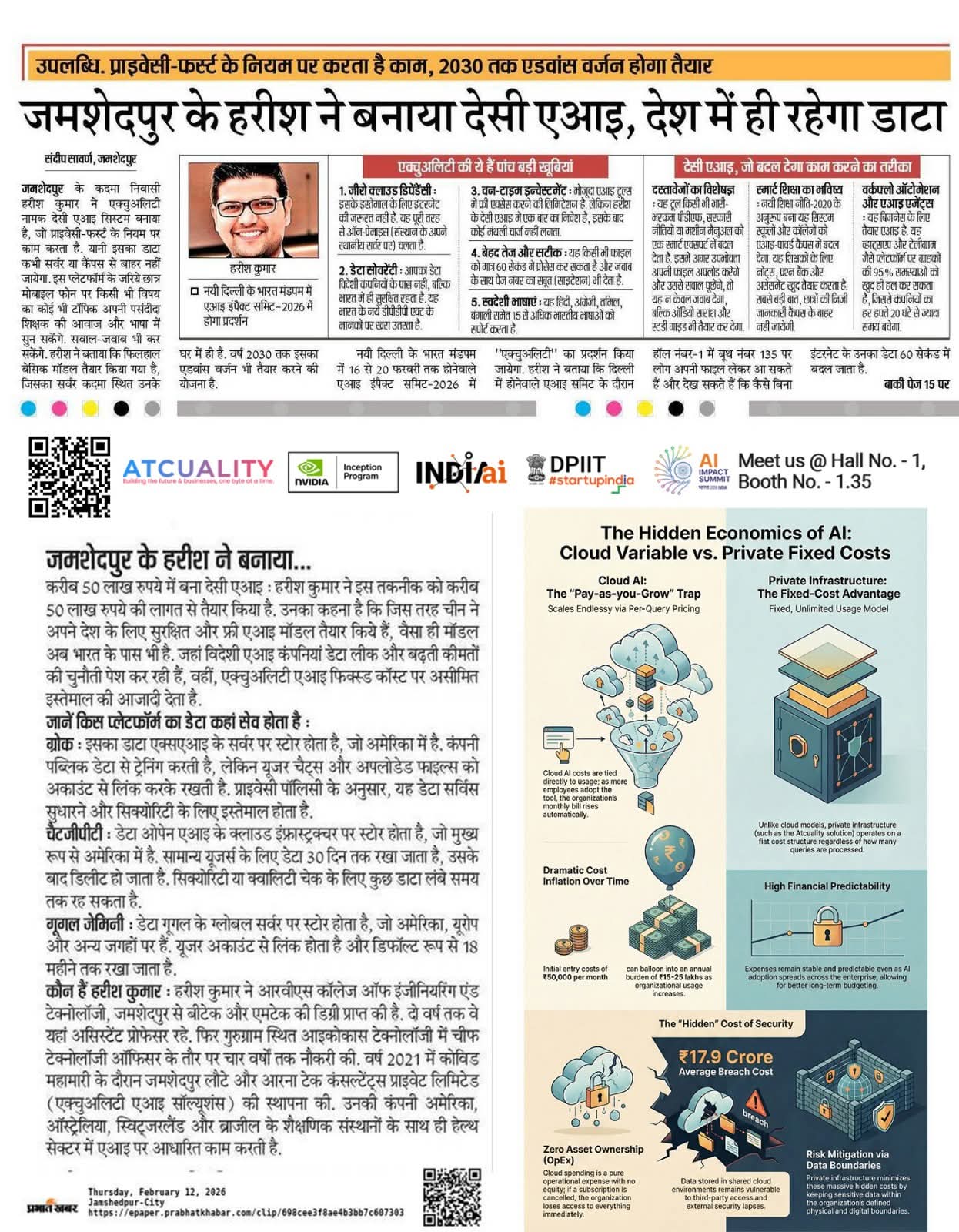
Big opportunity: Actuality will be demoed live at the ‘AI Impact Summit 2026’ at Bharat Mandapam, New Delhi from 16 to 20 February 2026. Visitors can stop by Hall No. 1, Booth 1.35 to see for themselves how the system processes data in 60 seconds — without an internet connection.
Five major strengths of Actuality
Zero cloud dependency: No internet required. Runs entirely on-premise — on the institution’s own local server.
Data sovereignty: Your data stays in India, not with foreign companies — fully aligned with the new DPDP Act standards.
One-time investment: Existing AI tools charge a subscription for every access. Here you invest once and pay no monthly fee.
Extremely fast and accurate: Processes any file in just 60 seconds and cites page-number evidence (Citation) with every answer.
Indian languages: Supports 15+ Indian languages including Hindi, English, Tamil and Bengali.
An indigenous AI that will change the way we work — three big use cases
1. Document expert
The tool turns any heavy PDF, institutional policy or machine manual into a smart expert. Users can upload their file and ask questions — the tool answers with page-number citations as proof.
2. The future of smart education
Aligned with the National Education Policy 2020, the system turns schools and colleges into AI-powered campuses. For teachers it:
Generates notes, question banks and assignments automatically.
Most important of all — student data never leaves the campus.
3. Workplace automation and AI agents
It’s ready for business too. On platforms like warehouses and telecom, it can resolve 95% of customer queries on its own — saving companies more than 20 hours a week.
An indigenous AI built for roughly ₹50 lakh
Harish Kumar built this technology at a cost of roughly ₹50 lakh. He says —
“Just as China has built secure and free AI models for its own country, India now has one too. While foreign AI companies confront us with the twin challenges of data leaks and rising prices, Actuality AI offers the freedom of unlimited use at a fixed cost.”
Where does each platform store your data?
Grok (xAI): Data is stored on xAI’s servers in the United States. The company trains on public data but keeps user chats and uploaded files linked to the account. Per its privacy policy, this data is used to improve the service and for security.
ChatGPT (OpenAI): Data is stored on OpenAI’s cloud infrastructure, primarily in the United States. For standard users, data is retained for 30 days and then deleted. Some data may be kept longer for security or quality checks.
Google Gemini: Data is stored on Google’s global servers — in the United States, Europe and elsewhere. It is linked to the user account and retained by default for 18 months.
BiltIQ (indigenous alternative): Data stays entirely in India, on the institution’s own server — it never leaves.
The hidden economics of AI: cloud variable vs private fixed costs
Cloud AI — the “Pay-as-you-Grow” trap
Starting cost from ₹50,000 per month.
As organisational usage grows, this can climb to ₹15–25 lakh per year.
Zero Asset Ownership (OpEx): cancel the subscription and everything is gone.
Hidden cost of security: the average data-breach cost is ₹17.9 crore.
Private infrastructure (a model like BiltIQ SI)
Fixed cost, unlimited usage.
High financial predictability — easy to budget for.
Risk mitigation: data stays within the organisation’s physical and digital boundaries.
Who is Harish Kumar?
Education: B.Tech & M.Tech — RVS College of Engineering and Technology, Jamshedpur.
Academic career: 2 years as Assistant Professor (RVS College).
Industry experience: 4 years as CTO — Aikokas Technology, Gurugram.
Return home: Returned to Jamshedpur in 2021 during the COVID-19 pandemic.
Company: Founded Aarna Tech Consultants Pvt Ltd (BiltIQ SI Solutions).
Global reach: Works with academic institutions in the United States, Australia, Switzerland and Brazil.
Sectors: AI-based solutions for education and healthcare.
Partners and recognition
BiltIQ has earned the support of several major organisations:
Part of the NVIDIA Inception Program.
Recognised by INDIAai.
Registered under DPIIT — #StartupIndia.
Official showcase at the AI Impact Summit 2026.