

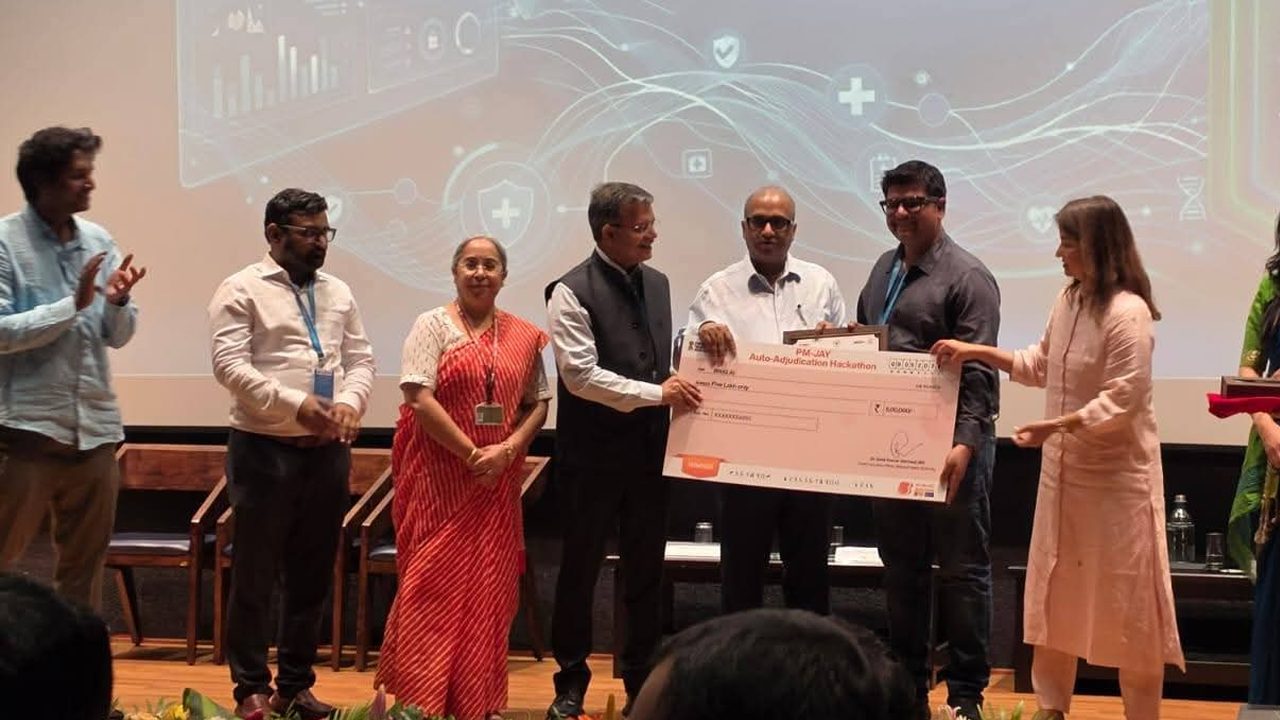
BiltIQ SI has been declared the winning team in Problem Statement 2 — Radiological Image-Based Condition Detection & Report Correlation at the National Health Authority’s PM-JAY AI Challenge, held at the Indian Institute of Science, Bangalore on 8 May 2026. The team’s pipeline answers a deceptively simple question for every radiology claim filed against Ayushman Bharat: does the evidence actually support what’s being billed?
The problem PM-JAY is staring at.
Pradhan Mantri Jan Arogya Yojana is the largest government-funded health insurance scheme in the world. It processes roughly 2.2 crore claims a year — and a meaningful share of those are radiology-driven. Every one of them arrives with two pieces of evidence: a DICOM image and a written report. Adjudicators correlate them by hand, three to five minutes per claim, at volume.
That hand-correlation step is where the system breaks. The image is hard to fake — it leaves a modality fingerprint, a scanner serial, a time-stamp. The report is easy to inflate. Words can describe pathology that the image does not show. At PM-JAY scale, even a single-digit fraction of inflated reports translates into thousands of crores leaking through the cracks of a scheme designed for the poorest Indians.
The image is hard to fake. The report is easy to inflate. Manual correlation is the bottleneck — and the fraud vector — that no payer has solved at scale.
How the winning pipeline works.
BiltIQ SI’s submission was not a single model. It was a three-layer adjudication stack that mirrors how a careful human reviewer actually triages a claim — checking authenticity, then compliance, then evidence — but at machine speed and with a paper trail at every step.
- Layer 01 — Integrity. Is the document real? Page classification, forgery detection, and tamper signatures on the submitted artefacts. Forged claims short-circuit the pipeline — nothing downstream runs.
- Layer 02 — Rules. Does the claim follow the rules? Field extraction, episode-timeline validation, and a Standard Treatment Guidelines (STG) rule engine that runs per-package compliance checks. Non-compliant claims get routed back to the hospital as queries — eligibility issues, not fraud.
- Layer 03 — Evidence (PS2 Winner). Does the evidence support what’s claimed? This is the layer that won the challenge. MedGemma 4B reads the image structure by structure. A medical-reasoner LLM reads the report and checks consistency against what the image actually shows. The system classifies every claim as Consistent, Partially supported, or Unsupported — with cited image evidence behind each verdict.
When the report describes pathology the image does not support, the system raises a high-priority fraud signal and escalates the claim. When everything aligns across all three layers, the claim auto-approves. The unified output is a single canonical JSON plus a one-page reviewer brief — auditable, citation-linked, and ready to drop into the NHA workflow as an FHIR Observation on the patient’s ABDM record.
Operational impact at PM-JAY scale: 2.2 Cr annual PM-JAY claims volume, a 70–80% target auto-approval rate, and the 3–5 min of manual correlation time replaced per claim.
Why this approach, and not a bigger model.
The instinct in AI adjudication is to throw a frontier multimodal model at the problem and trust the score. BiltIQ SI’s pitch made the opposite argument: that radiology adjudication has three distinct cost-of-failure curves — document forgery, rule violation, and evidence mismatch — and collapsing them into a single black-box decision destroys the audit trail that a public payer like NHA needs to defend every approval and every denial.
The team built the system on three principles that have come to define BiltIQ SI’s engineering work across healthcare and government:
- Domain-first. The pipeline was designed from the claim-adjudication workflow outward, not from model capability inward. Each layer maps to a step a real reviewer already performs.
- Traceable. Every output links to image evidence or a firing rule. Never a black box. NHA can defend any verdict the system produces, line by line.
- Assistive. The system informs human judgment — it does not replace it. The output is a brief for a reviewer, not a final disposition.
Where it goes from here.
The win at IISc is a starting point, not a finish line. Conversations with NHA on integration pathways have begun. The architecture deliberately respects the constraints of a national programme: on-premise inference, no patient data leaving the sovereign infrastructure, and a deployment topology that fits how empanelled hospitals and TPAs already operate.
It is also a signal of where the company places its bets. PsyOS in behavioural health. AI Campus in education. ATC Manthan in document intelligence. And now, a winning entry in the country’s largest public-health adjudication problem. The thread tying all of it together is the same conviction the team has held since 2021: sensitive data never leaves the building, and the AI never leaves the data.
The team behind the win.
- Harish Kumar — Co-Founder · CEO.
- Bijendra Kr Singh — BiltIQ SI.
- Anil Dubey — BiltIQ SI.
The work was submitted under Aarna Tech Consultants Private Limited, BiltIQ SI’s parent entity — a DPIIT-recognised startup and NVIDIA Inception partner, headquartered in Jamshedpur.