

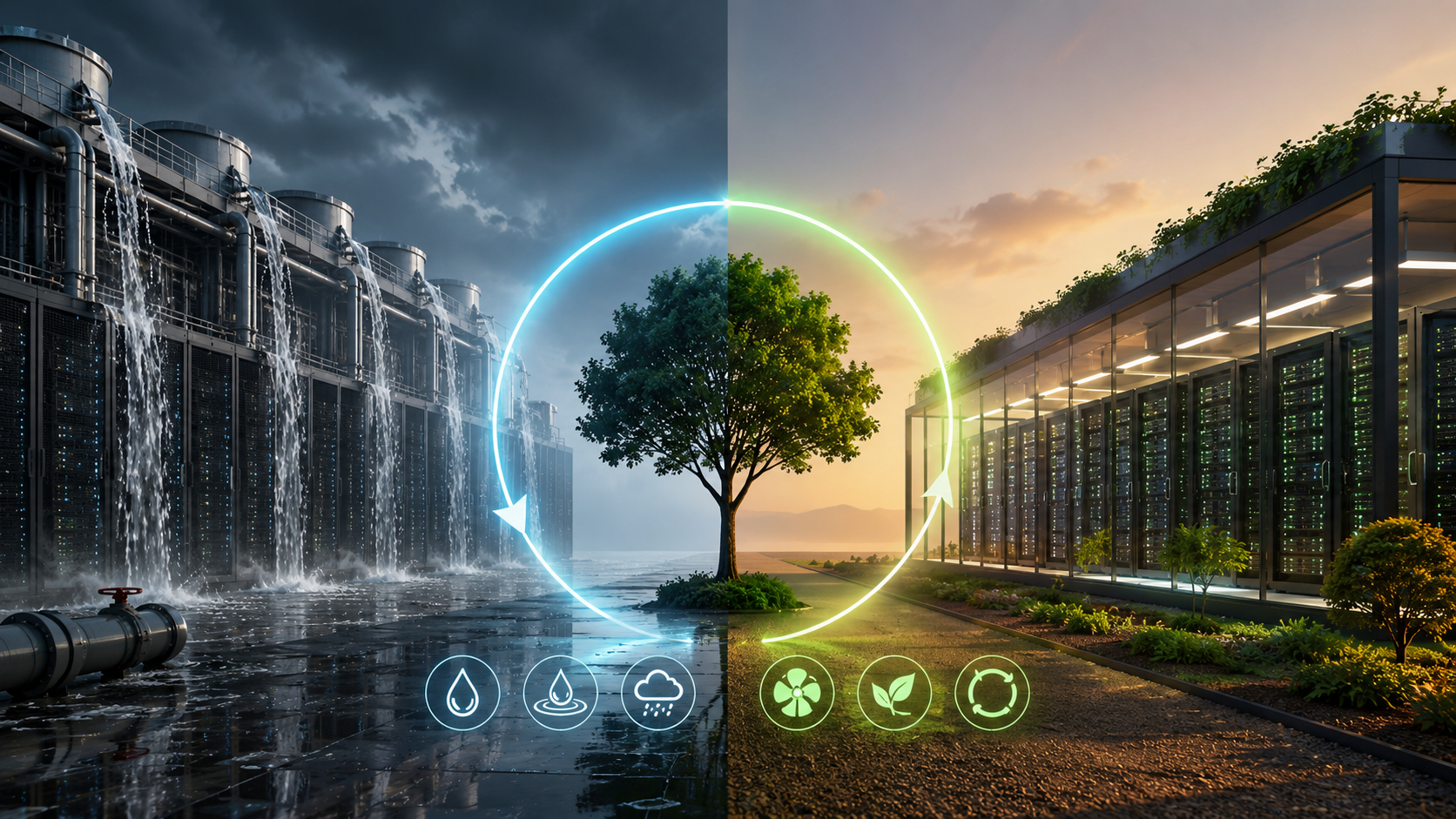
The industry-average SI data center consumes 1.8–1.9 litres of water per kilowatt-hour — evaporated and gone — while an office air-conditioning unit rejecting the same heat is a closed loop that consumes zero. That single physical fact is the clearest argument for running enterprise SI on-premises instead of in a hyperscale facility, and it has nothing to do with marketing and everything to do with thermodynamics.
Where the water actually goes
Almost all the electricity a server draws leaves the building as heat. A GPU doing inference is, thermally speaking, a very expensive space heater: the useful work is information, and nearly every watt consumed must eventually be rejected to the environment.
At hyperscale, the cheapest way to reject that heat is evaporative cooling. Water is sprayed or trickled over heat exchangers, absorbs the thermal load, and leaves as vapour. It is not recycled, not returned to the basin it came from — it is evaporated and gone. At the industry average of 1.8–1.9 litres per kWh, a facility drawing megawatts consumes water on the scale of a small town.
Now place that in the Indian context. NITI Aayog counts roughly 600 million people in India living under high-to-extreme water stress. Every enterprise query sent to a cloud SI API adds a small, invisible draw against that shared resource — a draw made in a building the enterprise will never see, in a basin it may well share.
An office AC unit works differently. It rejects the same heat through a compressor and condenser — a closed loop. Refrigerant circulates; nothing evaporates into the atmosphere except heat itself. Zero litres, by design.
The threshold argument: small enough that water was never the default
Here is the part of this argument most vendors never make, because it cuts against the way they've built.
Avoiding water consumption at data-center scale takes deliberate, costly engineering — dry coolers, immersion systems, chilled-water plants with closed circuits — engineering most operators skip because evaporative cooling is cheaper. Avoiding water at office scale takes nothing more than the air conditioning already running for the people in the room.
The real lever isn't greener data-center technology. It's staying small enough that water was never the cheap default in the first place. That is a threshold argument: below a certain thermal load, the water problem simply doesn't exist, because the building's existing closed-loop cooling absorbs it for free.
The BiltIQ SI Factory is designed to live below that threshold, permanently:
- One AC unit, one wall socket. No server room, no chiller, no raised floor, no water line. The fleet is cooled by the air conditioning already running for the people in the room.
- Five desk-size nodes, one office LAN. Growth means adding a node over the LAN — no InfiniBand, no re-architecture — with roughly 500 GB of fleet model memory across the cluster.
- Heat rejected, water untouched. Every watt still leaves as heat; it just leaves through a closed-loop AC instead of an evaporative tower.
- A load rooftop solar can plausibly cover. A 300–500 W typical fleet draw is within reach of a rooftop solar installation. A data center's megawatts never will be.
The power ledger — measured, not modelled
Every figure below is measured by BiltIQ's own cluster analytics at ₹10/kWh — live telemetry from a deployed fleet, not vendor datasheet estimates or modelled projections.
| Scenario | Draw | Annual energy | Annual cost |
|---|---|---|---|
| SI Factory, typical serving | ~300–500 W | ~3,500 kWh | |
| SI Factory, worst case, 24/7 at full load | ~1.7 kW | ~14,900 kWh | |
| One 8×H100 cloud-class server (the thing being replaced) | 10.2 kW | ~89,000 kWh | ~₹8.9 L + chilled-water cooling |
Read that middle row carefully, because it's the honest one. Even the worst case — every node in the fleet running flat-out, twenty-four hours a day, all year — sits at roughly 1.7 kW. That is inside what a single domestic air conditioner already handles. There is no configuration of this fleet that requires a chiller, a raised floor, or a water line.
The contrast row matters just as much. One 8×H100 cloud-class server — the standard unit of "serious" SI infrastructure — draws 10.2 kW continuously, consumes ~89,000 kWh a year, and requires chilled-water cooling on top of its ₹8.9 lakh power bill. The SI Factory's whole-fleet worst case is a sixth of that server's draw; its typical case is a twentieth.
Why a small hospital should care about a cooling tower it will never see
For BiltIQ's two lead sectors — healthcare and BFSI — the water argument connects directly to procurement realities that are usually discussed under different headings.
ESG reporting is starting to ask the question. Enterprises reporting on sustainability increasingly need to account for the environmental footprint of their digital infrastructure. "Our SI runs on 300–500 watts, cooled by our existing office AC, consuming zero litres of water" is a sentence a sustainability officer can put in a report. "Our SI runs somewhere in a hyperscaler's fleet" is a disclosure gap.
Water risk is a business-continuity risk. Data centers in water-stressed regions face growing regulatory and community pressure. An enterprise whose SI capability depends on such a facility has inherited that facility's water politics. An enterprise whose SI runs in its own building has not.
The thermal plan is also the sovereignty plan. The same architectural choice that eliminates water — keeping the compute small and local — is the choice that keeps patient records, credit files, and case documents inside the building. Zero water and zero cloud are not two features; they are one decision viewed from two angles. (For the data-residency side of that decision, see our piece on [why enterprise SI moved back inside the building].)
What this is not
To keep this claim honest, it's worth stating its boundaries plainly.
This is not a claim that on-premises SI uses no energy — it uses about ₹35,000 of electricity a year for a typical serving fleet, and we publish the worst case alongside it. It is not a claim that all data centers are wasteful — hyperscale facilities are extraordinarily efficient per watt; their water use is a consequence of their scale, not incompetence. And it is not an offset, a credit, or a pledge. It is an architecture: the fleet evaporates no water because, at this size, there is nothing for water to do.
The BiltIQ SI Factory runs enterprise SI — models, agents, retrieval, privacy, and audit — on desk-size nodes powered from wall sockets and cooled by the AC you already own. Book a consultation: [email protected] · +91 89868 60088 · www.biltiq.ai
Frequently asked questions
Does zero water mean zero heat?
No — every watt the fleet draws still leaves the building as heat; it simply leaves through a closed-loop air conditioner instead of an evaporative cooling tower. The distinction is the medium of heat rejection, not the existence of heat. An office AC transfers heat outdoors via refrigerant in a sealed circuit, consuming electricity but no water.
How much water does a typical SI data center actually use?
The industry-average data center consumes roughly 1.8–1.9 litres of water per kilowatt-hour it draws, evaporated through cooling towers and gone. For a facility drawing megawatts continuously, that compounds to a municipal-scale water draw — which is why the figure matters in a country where NITI Aayog counts about 600 million people under high-to-extreme water stress.
Can rooftop solar really power an SI fleet?
A typical serving draw of 300–500 W for the whole fleet is within the plausible output of a commercial rooftop solar installation, which is the honest version of this claim. A data center's megawatt-scale demand is not solar-coverable from its own roof under any realistic scenario. The worst case for the fleet — 24/7 at full load, ~1.7 kW — is larger but still domestic-scale.
Are these power figures estimates or measurements?
They are measurements: throughput, draw, and cost figures are taken from BiltIQ's own cluster analytics at ₹10/kWh — live telemetry on deployed hardware, not vendor datasheets. We publish the worst case (₹1.5 lakh/year at 24/7 full load) next to the typical case (₹35,000/year) precisely so the number survives scrutiny.
Does the closed-loop approach limit how far the fleet can scale?
Scaling means adding desk-size nodes over the office LAN — no InfiniBand fabric and no re-architecture — and each node adds only 240 W of maximum draw. A fleet grows within what ordinary office cooling handles for a long way; an organisation that genuinely outgrows one AC unit adds another AC unit, not a chilled-water plant.
Is an air-gapped deployment still zero-water?
Yes — air-gapping is a network property, not a thermal one, and the fleet runs fully air-gapped for classified or regulated environments with exactly the same cooling profile. Each node is silent, plugs into a normal wall socket, and rejects heat through the room's existing air conditioning.