

The same million tokens of enterprise SI work that costs $2–15 on a cloud API costs roughly ₹15–20 of electricity on an on-premises fleet — a gap of 50–500×, measured on live cluster telemetry rather than modelled. Understanding why that gap exists, and where it does and doesn't apply, is the whole substance of the on-prem vs cloud cost question.
The business model behind the meter
Cloud SI billing rises every time your team actually uses the tool. That is not a side effect — it is the business model. Every query, every document ingested, every agent loop turns a meter denominated in tokens. The perverse consequence is that adoption success and cost growth become the same line on the same chart: the better your staff get at using SI, the larger the invoice.
On-premises SI inverts the structure of the bill. The costs are:
- Hardware, once (capex — or nothing, on the rented-GPU path below),
- Electricity, continuously (a flat, small line), and
- Maintenance, as a predictable annual contract.
There is no per-token fee and no per-seat licence. Usage grows without the bill growing.
The headline comparison, with its scenario stated
Every serious cost claim should state the scenario it describes, so here is ours: the figures below are for grounded enterprise inference on BiltIQ's own deployed fleet, measured by cluster analytics at ₹10/kWh — live telemetry, not estimates.
| Cost line | Cloud API | On-premises (BiltIQ fleet) |
|---|---|---|
| Per million tokens | $2–15 | ₹15–20 of electricity |
| Whole-fleet electricity, typical serving, per year | — | |
| Marginal cost of an additional user on a live fleet | scales with usage | ~₹0 |
| Water consumed | (facility-dependent) | 0 litres |
For the full three-year total-cost-of-ownership picture at a specific usage tier (1 million queries/month), see the detailed TCO table on our SI Factory page — different usage scales produce different savings percentages, which is exactly why we state scenarios rather than quoting one universal number.
Load tiers: what the fleet actually costs to buy and run
We size fleets to concurrency, never to a fixed bill of materials — a fixed spec is how a buyer ends up paying for capacity they never use. These are the reference tiers:
| Tier | Users · concurrency | Fleet | Capex | Draw | Power/yr |
|---|---|---|---|---|---|
| Departmental | 20–30 · ~5 concurrent | 1× DGX Spark | ~₹5L | 240 W | ~₹7,000 |
| Business unit | 100–150 · ~15–20 | 3× DGX Spark | ~₹15L | ~720 W | ~₹20,000 |
| Enterprise + multimodal | 300+ · vision and speech | 3× Spark + 1× RTX PRO 6000 | ~₹28L | ~1.3 kW | ~₹35,000 |
| Rented GPU instead | any tier — identical stack | — | nil | — | ₹1.3–3.6L/yr |
| One 8×H100 server, for contrast | the thing being replaced | — | — | 10.2 kW | ~₹8.9L + chilled water |
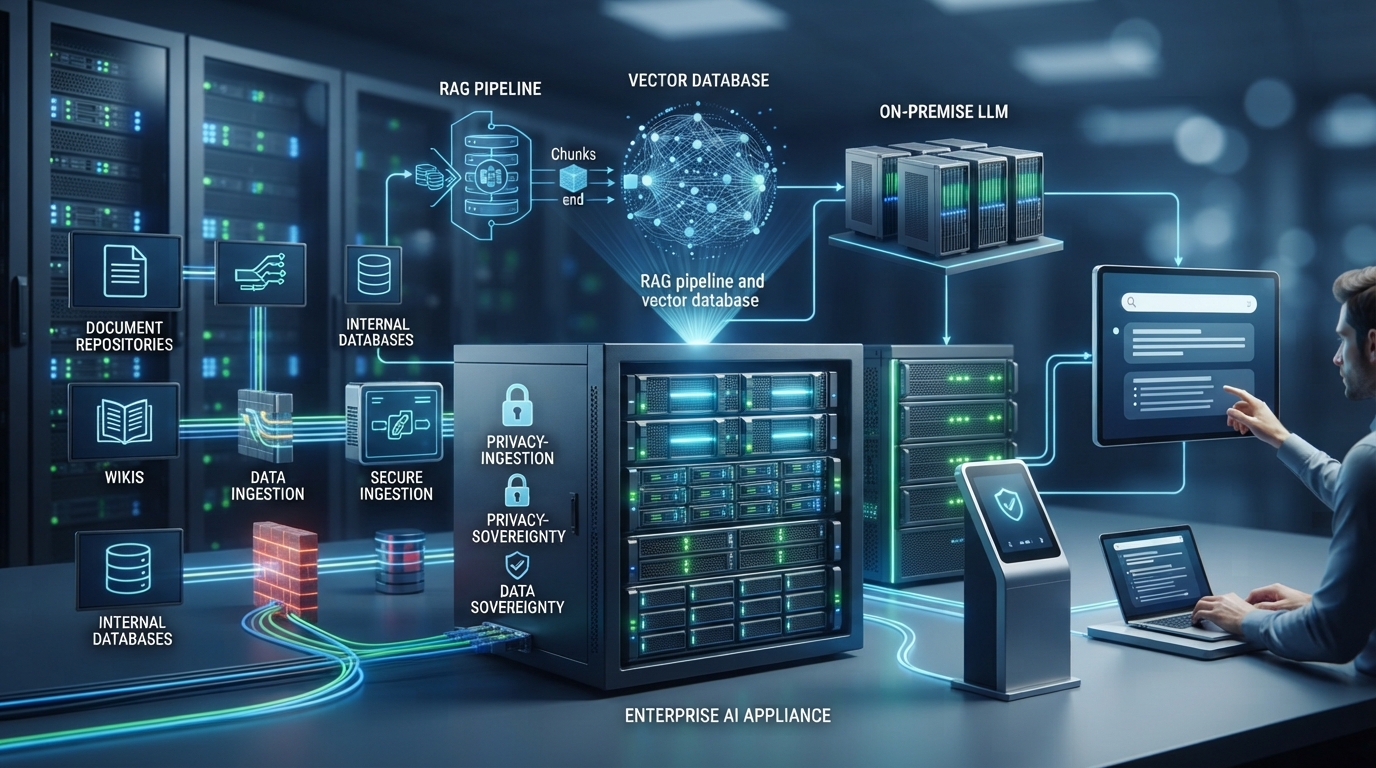
The sizing unit underneath all of this: one DGX Spark serves roughly five concurrent requests — a 20–30 person office, or a small hospital with three or four doctors working at once. Growth means adding a node over the office LAN, never a re-architecture.
Why the economics invert: three mechanisms
Capex once — own the plant. Hardware is a one-time purchase, and at these load tiers, a year of electricity for the entire fleet costs less than a month of comparable API spend for sustained enterprise usage. The plant, once installed, is an asset on your books rather than a subscription on your P&L.
Opex ≈ zero — the free marginal token. Once the fleet is serving, the marginal token is a power bill. The measured cost of an additional user on a live fleet is approximately ₹0, because the hardware is already drawing its 240 W per node whether it serves four users or five. No per-token fees, no per-seat licences — usage grows without the bill growing. This is the structural difference no cloud discount can match: a discount lowers the slope of a rising line; ownership makes the line flat.
Compounding — your alpha stays home. Every conversation and every document processed enriches a knowledge graph on your own hardware. Nothing feeds an outside model, which means the asset appreciating from your organisation's daily work is your asset. On a cloud API, that compounding accrues — at best — to nobody, and at worst to the vendor.
The honest objection: capital intensity
The strongest argument against on-premises SI is the one we'd rather raise ourselves: it requires capital up front, and cloud APIs do not. Two things blunt it.
First, the rented-GPU path. The identical stack — same open models, same retrieval, same privacy rail — runs on rented GPUs at ₹1.3–3.6 lakh per year at any tier, with zero capex. Buyers who will not sign a hardware purchase order get the sovereignty of the software layer and the flat cost structure immediately; the hardware can follow when a budget cycle allows. No rewrite is needed to move between the two.
Second, the scale of the capex itself. A departmental deployment starts at roughly ₹5 lakh of hardware — a figure closer to a few high-end laptops than to a data-center buildout. The contrast row in the table above is the point: the thing this fleet replaces is a 10.2 kW server costing ₹8.9 lakh per year in electricity alone, before chilled-water cooling.
Who this math is for — and who it isn't for
This cost structure favours organisations with sustained, recurring SI usage: hospitals processing patient documents daily, banks whose staff query credit files and policy continuously, engineering firms searching drawings and tenders as part of every project. For them, the meter is the enemy, and flat electricity wins decisively.
It favours them least at the very beginning: an organisation running a two-week pilot with ten queries a day should absolutely use metered pricing — that's what metering is good at. The crossover comes with adoption, which is precisely the moment cloud billing starts to punish success. Our position is simply that enterprises should do this arithmetic before adoption succeeds, not after the first surprising invoice.
How to run this comparison for your own organisation
Three inputs determine which side of the crossover you sit on, and all three are knowable before you buy anything. First, estimate sustained monthly token volume — not the pilot's volume, but what usage looks like once staff adopt the tool, because adoption is exactly when metered billing bites. Second, count peak concurrency, not headcount: concurrency is what hardware is sized to, and one node's ~5 concurrent requests covers more people than most buyers expect. Third, price the compliance requirement — if your sector requires data residency or air-gapped operation anyway, the on-premises path stops being a cost decision and becomes the only path that satisfies procurement, with the economics arriving as a bonus.
The bottom line
Own the compute, own the data, own the outcome — priced in electricity, not tokens. The numbers above are published so a CFO can check them: per-million-token cost, per-tier capex, per-year power, worst case included, all measured on a deployed fleet.
The BiltIQ SI Factory is enterprise SI installed in your building: hardware sized to your workload, open models, orchestration, and retrieval grounded in your own documents. Book a consultation: [email protected] · +91 89868 60088 · www.biltiq.ai
Frequently asked questions
How much cheaper is on-premises SI than cloud APIs?
On a per-million-token basis, measured on BiltIQ's deployed fleet at ₹10/kWh, on-premises inference costs ₹15–20 of electricity versus $2–15 on cloud APIs for comparable enterprise work — roughly 50–500× lower marginal cost. Total-cost-of-ownership savings over multiple years depend on usage volume, which is why we publish scenario-specific TCO tables rather than a single universal percentage.
What does an on-premises SI deployment cost up front?
Reference hardware tiers run from about ₹5 lakh (one DGX Spark node serving a 20–30 person department) to about ₹28 lakh (a multimodal enterprise fleet for 300+ users), with your actual base configuration quoted after a workload assessment. Organisations that won't commit capex can run the identical stack on rented GPUs at ₹1.3–3.6 lakh per year with zero upfront hardware cost.
What are the ongoing costs after installation?
Electricity is the dominant recurring infrastructure cost, at roughly ₹7,000–₹35,000 per year depending on fleet tier for typical serving, plus an annual maintenance contract. There are no per-token fees and no per-seat licences at any usage volume.
Does cost per user rise as more staff use the system?
No — the measured marginal cost of an additional user on a live fleet is approximately ₹0, because installed hardware draws the same power whether utilisation is partial or full. Capacity is added in discrete steps (one node at a time over the office LAN) only when concurrency genuinely outgrows the current fleet.
Is there a way to get on-premises economics without buying hardware?
Yes — the rented-GPU path runs the identical software stack (same open models, retrieval, and privacy rail) on rented infrastructure at ₹1.3–3.6 lakh per year at any tier. It preserves the flat, non-metered cost structure and data-sovereignty posture while deferring the hardware purchase decision.
Are these figures modelled or measured?
Measured: throughput, power draw, and cost-per-million-token figures come from BiltIQ's own cluster analytics at ₹10/kWh on deployed hardware. We publish the worst case alongside the typical case, and every scenario-dependent figure states its scenario.