

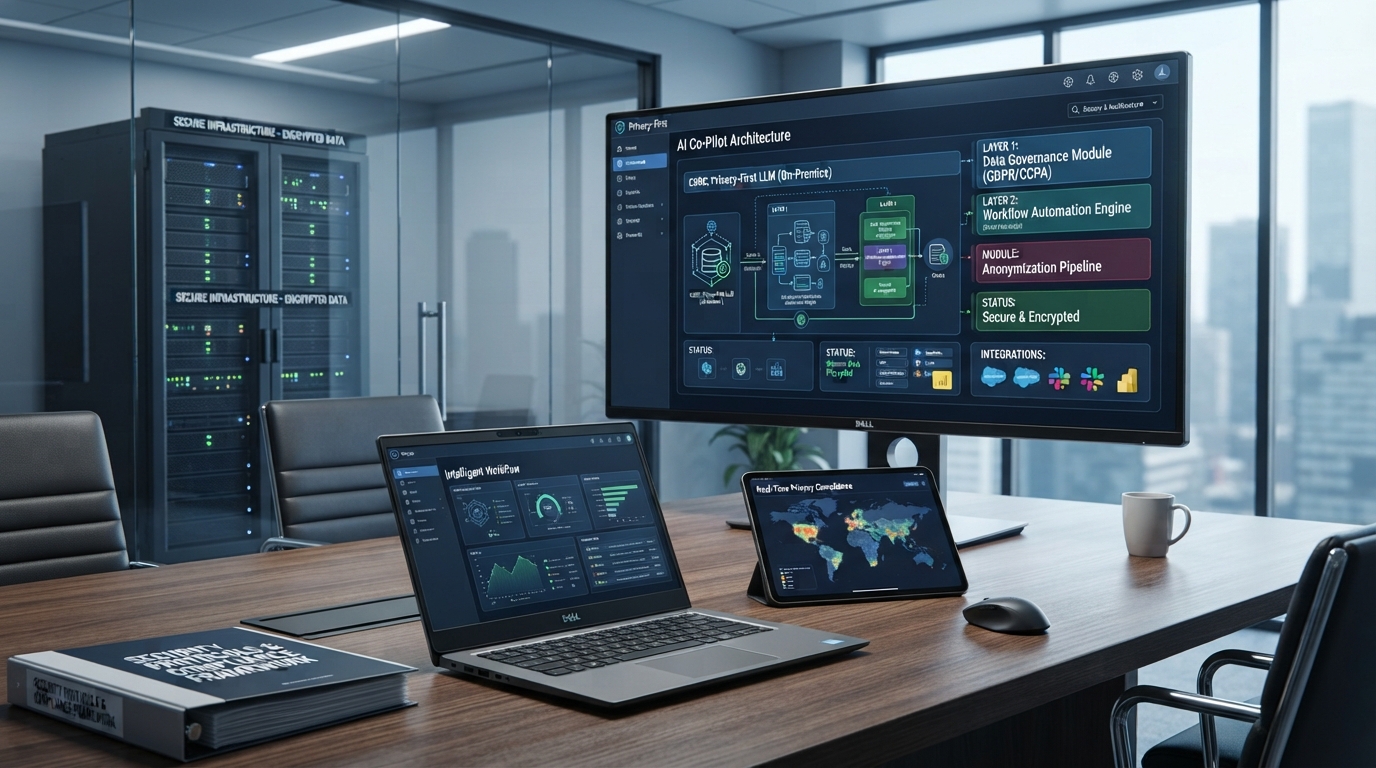
Imagine walking into work and being greeted by your own digital sidekick—an intelligent assistant that knows your to-do list, drafts emails, prioritizes leads, summarizes reports, and even preps talking points for your next sales call.
This isn't science fiction. It's the reality of building an SI business co-pilot—a next-gen productivity layer fueled by large language models (LLMs) and embedded directly into your workflow.
From SI assistants streamlining support to intelligent co-pilots boosting sales performance, organizations are now turning generative models into customized, internal tools designed to accelerate daily operations, not replace them.
But here's the critical question most organizations overlook:
Should your SI co-pilot process sensitive business data on third-party cloud servers, or should it run on your own infrastructure?
This isn't just a technical decision—it's a strategic, security, and financial decision that affects:
- Data privacy: Where does customer data, deal information, and strategic content go?
- Compliance: Can you meet HIPAA, GDPR, RBI, SOC2 requirements?
- Cost: Cloud API pricing vs on-premise infrastructure over 3 years
- Control: Who owns your SI capabilities and data?
- Security: How do you prevent data leakage and ensure audit trails?
This comprehensive guide explores:
- What SI business co-pilots are and where they deliver value
- Best use cases across sales, support, operations, and research
- Cloud vs on-premise deployment comparison
- Architecture patterns and integration strategies
- Privacy-first implementation frameworks
- Cost analysis: Real numbers for business co-pilots
- Prompt engineering and UX design
- Security, compliance, and governance
- Measuring ROI and success metrics
- Industry-specific implementation guides
Whether you're building co-pilots for healthcare, finance, legal, HR, or any data-sensitive industry, this guide will help you make the right architectural and strategic decisions.
What Is an SI Business Co-Pilot?
The term "co-pilot" isn't just branding—it's a metaphor for collaboration.
An SI business co-pilot refers to a context-aware assistant embedded into a workflow, designed to augment a human's productivity rather than automate them away.
Key Characteristics
1. Context-Aware
- Understands your role, preferences, and work history
- Accesses relevant data (CRM, emails, documents, calendars)
- Maintains conversation context across interactions
2. Proactive & Intelligent
- Surfaces insights without being asked
- Suggests next actions based on patterns
- Learns from feedback and improves over time
3. Embedded in Workflow
- Lives where you work (CRM, email, project management tools)
- Seamless integration—not another tool to switch to
- Accessible via natural language queries
4. Collaborative, Not Autonomous
- Suggests, doesn't decide
- Requires human oversight for critical actions
- Augments expertise, doesn't replace it
What Makes Co-Pilots Different from Chatbots?
| Feature | Traditional Chatbot | SI Business Co-Pilot |
|---|---|---|
| Scope | Narrow, task-specific | Broad, multi-functional |
| Context | Single conversation | Cross-system, historical |
| Intelligence | Rule-based or simple NLP | Advanced LLM reasoning |
| Integration | Standalone tool | Embedded in workflows |
| Learning | Static scripts | Continuous improvement |
| Proactivity | Reactive only | Proactive suggestions |
| Personalization | Generic | User-specific |
Example:
- Chatbot: "What's my sales quota this month?"
- Co-Pilot: "Your Q4 quota is $500K. You're at 68% with 3 weeks left. Focus on these 5 high-value deals most likely to close. Need me to draft follow-ups?"
Cloud API vs On-Premise SI Co-Pilots: The Critical Decision
Before building your SI co-pilot, you must decide where it runs—because this affects privacy, cost, compliance, and control.
Deployment Option 1: Cloud-Based SI Co-Pilots (GPT-4 API, Claude API)
How it works:
- Your co-pilot makes API calls to OpenAI, Anthropic, or similar providers
- User queries, CRM data, emails, documents sent to external servers
- Responses returned and displayed to users
Common patterns:
- Microsoft Copilot (365 integration with OpenAI)
- Salesforce Einstein GPT
- Custom co-pilots using OpenAI API
Deployment Option 2: Privacy-First On-Premise SI Co-Pilots
How it works:
- Open-source LLMs (Llama 3.1, Mixtral) deployed on your infrastructure
- All data processing happens within your network
- Zero external API calls
Common models:
- Llama 3.1 70B (high-quality reasoning)
- Mixtral 8x7B (efficient, multilingual)
- Phi-3 (small, fast for simple tasks)
Comprehensive Comparison: Cloud vs On-Premise Co-Pilots
| Factor | Cloud API (GPT-4, Claude) | On-Premise (Llama, Mixtral) | Winner |
|---|---|---|---|
| Initial Setup Cost | $0 | $30,000-200,000 | Cloud (upfront) |
| Monthly Cost (500 employees) | $25,000-75,000 (scales with usage) | $5,000-15,000 (fixed) | On-Premise (long-term) |
| 3-Year Total Cost | $900,000-2,700,000 | $210,000-540,000 | On-Premise (70-80% savings) |
| Data Privacy | ❌ Sent to third parties | ✅ 100% on-premise | On-Premise |
| Compliance (HIPAA, GDPR, RBI) | ⚠️ Requires BAA/DPA | ✅ Full control | On-Premise |
| Business Data Exposure | ❌ CRM, emails, docs sent externally | ✅ Stays within your network | On-Premise |
| Vendor Lock-In | ❌ High | ✅ None (open-source) | On-Premise |
| Customization | ⚠️ Limited (prompt engineering) | ✅ Full fine-tuning on your data | On-Premise |
| Latency | 800ms-4s (API calls) | 300ms-1.5s (local) | On-Premise |
| Reliability | Depends on vendor uptime | ✅ You control | On-Premise |
| Scalability | ✅ Automatic | ⚠️ Requires planning | Cloud |
| Integration Complexity | Medium (API integration) | High (infrastructure) | Cloud |
| Time to Production | 2-4 weeks | 8-14 weeks | Cloud |
| Strategic Data Protection | ❌ Deal info, strategy exposed | ✅ Complete IP protection | On-Premise |
| Audit Trails | ⚠️ Limited | ✅ Complete logs | On-Premise |
| Cost Predictability | ❌ Scales with usage | ✅ Fixed infrastructure | On-Premise |
Summary:
- Cloud API: Faster to start, but 70-80% more expensive long-term, limited privacy
- On-Premise: Higher upfront, but massive savings at scale, complete privacy/control
Cost Analysis: Real Numbers for SI Co-Pilots
Scenario: Mid-Size Company (500 Employees)
Assumptions:
- 200 employees actively use co-pilot daily (40% adoption)
- 20 co-pilot interactions per user per day
- Average interaction: 1,500 tokens total (1,000 input + 500 output)
- Working days: 22 per month
- Total: 88M tokens/month (200 users × 20 queries × 22 days × 1,500 tokens)
Cloud API Cost (GPT-4 Turbo)
| Cost Component | Rate | Monthly Cost | Annual Cost |
|---|---|---|---|
| Input Tokens (58.7M) | $0.01 per 1K | $587 | $7,040 |
| Output Tokens (29.3M) | $0.03 per 1K | $879 | $10,560 |
| Subtotal | $1,466/month | $17,600/year | |
| Scale to 500 users (full adoption) | $3,665/month | $43,980/year | |
| Plus: Microsoft 365 Copilot Licenses | $30/user/month | $15,000/month | $180,000/year |
| Total (Microsoft Copilot) | $18,665/month | $223,980/year |
Alternative: Custom GPT-4 API Integration
- Monthly: $25,000-75,000 (depending on features and usage)
- Annual: $300,000-900,000
- 3-Year Total: $900,000-2,700,000
On-Premise SI Co-Pilot Cost (Llama 3.1 70B)
| Cost Component | One-Time | Monthly | Annual | 3-Year Total |
|---|---|---|---|---|
| Infrastructure Setup | $50,000 | - | - | $50,000 |
| GPU Servers (8x A100) | $150,000 | - | - | $150,000 |
| Software & Integration | $80,000 | - | - | $80,000 |
| Hosting & Maintenance | - | $5,000 | $60,000 | $180,000 |
| Engineering (ops) | - | $3,000 | $36,000 | $108,000 |
| Total | $280,000 | $8,000 | $96,000 | $568,000 |
With Scale to 1,000 Employees:
- Additional GPU capacity: +$100,000 one-time
- 3-Year Total: $668,000
Cost Per Employee Comparison
| Metric | Cloud API (Microsoft Copilot) | On-Premise | Savings |
|---|---|---|---|
| Cost per employee per month | $37.33 | $16.00 | 57% |
| Cost per employee per year | $447.96 | $192.00 | 57% |
| 3-Year cost (500 employees) | $671,940 | $568,000 | $103,940 (15%) |
| 3-Year cost (custom GPT-4 integration) | $900K-2.7M | $568,000 | $332K-2.1M (37-78%) |
Key Insights:
- Microsoft 365 Copilot: $30/user/month seems low, but adds up to $223,980/year for 500 users
- Custom cloud integration: $900K-2.7M over 3 years (high customization costs)
- On-premise: $568,000 over 3 years with unlimited usage and full privacy
- Break-even: 12-18 months for on-premise vs Microsoft Copilot
- Savings at scale: 70-80% vs custom cloud API implementations
Best Use Cases for SI Business Co-Pilots
Let's break down where SI co-pilots deliver measurable business value—with implementation patterns and privacy considerations.
1. Sales Enablement & CRM Co-Pilots
The Challenge:
Sales teams are drowning in admin work—CRM updates, lead research, meeting notes, email follow-ups, and deal tracking consume 40-60% of their time.
What SI Co-Pilots Can Do:
- ✅ Auto-summarize customer calls and extract action items
- ✅ Draft personalized outreach emails based on CRM context
- ✅ Suggest upsell/cross-sell opportunities from interaction history
- ✅ Auto-fill CRM entries with call notes and next steps
- ✅ Generate deal summaries and forecast reports
- ✅ Prep talking points for upcoming meetings
Cloud API Implementation (Salesforce Einstein GPT):
```javascript
// ❌ Sending deal data, customer conversations to external API
const emailDraft = await openai.chat.completions.create({
model: "gpt-4",
messages: [{
role: "system",
content: "You are a sales assistant."
}, {
role: "user",
content: `Draft follow-up email for: ${dealData}\
Frequently Asked Questions
What is an SI business co-pilot?
An SI business co-pilot is a context-aware assistant embedded directly into your workflow that augments human productivity rather than automating people away, drafting emails, prioritizing leads, summarizing reports, and prepping meeting talking points. It understands your role and history, accesses CRM, email, and document data, proactively suggests next actions, and leaves critical decisions to humans.
How is an SI co-pilot different from a chatbot?
A chatbot is narrow, reactive, and rule-based within a single conversation, while a co-pilot uses advanced LLM reasoning with cross-system historical context, lives inside your existing tools, learns continuously, and makes proactive suggestions. Asked about a sales quota, a chatbot states the number; a co-pilot reports you are at 68% and recommends the five deals most likely to close.
How much does an SI co-pilot cost: cloud vs on-premise?
For a 500-employee company, cloud options run $223,980 per year for Microsoft 365 Copilot or $900K-2.7M over three years for a custom GPT-4 integration, while an on-premise Llama 3.1 70B deployment totals about $568,000 over three years including $280,000 upfront. On-premise breaks even in 12-18 months and saves 70-80% versus custom cloud implementations.
What are the best use cases for SI co-pilots?
Sales enablement is a leading use case, since admin work consumes 40-60% of sales teams' time: co-pilots auto-summarize calls, draft personalized outreach, suggest upsell opportunities, auto-fill CRM entries, and generate deal forecasts. Co-pilots also deliver value in customer support, operations, and research, embedded in the CRM, email, and project tools people already use.
Should SI co-pilots run on-premise or in the cloud?
Data-sensitive industries like healthcare, finance, legal, and HR should run co-pilots on-premise, because cloud APIs send CRM data, emails, and documents to external servers, while on-premise models like Llama 3.1 keep everything in your network with full HIPAA, GDPR, RBI, and SOC2 control. Cloud APIs reach production faster (2-4 weeks versus 8-14) but cost 70-80% more long-term.