Imagine two employees starting SI training on the same day:
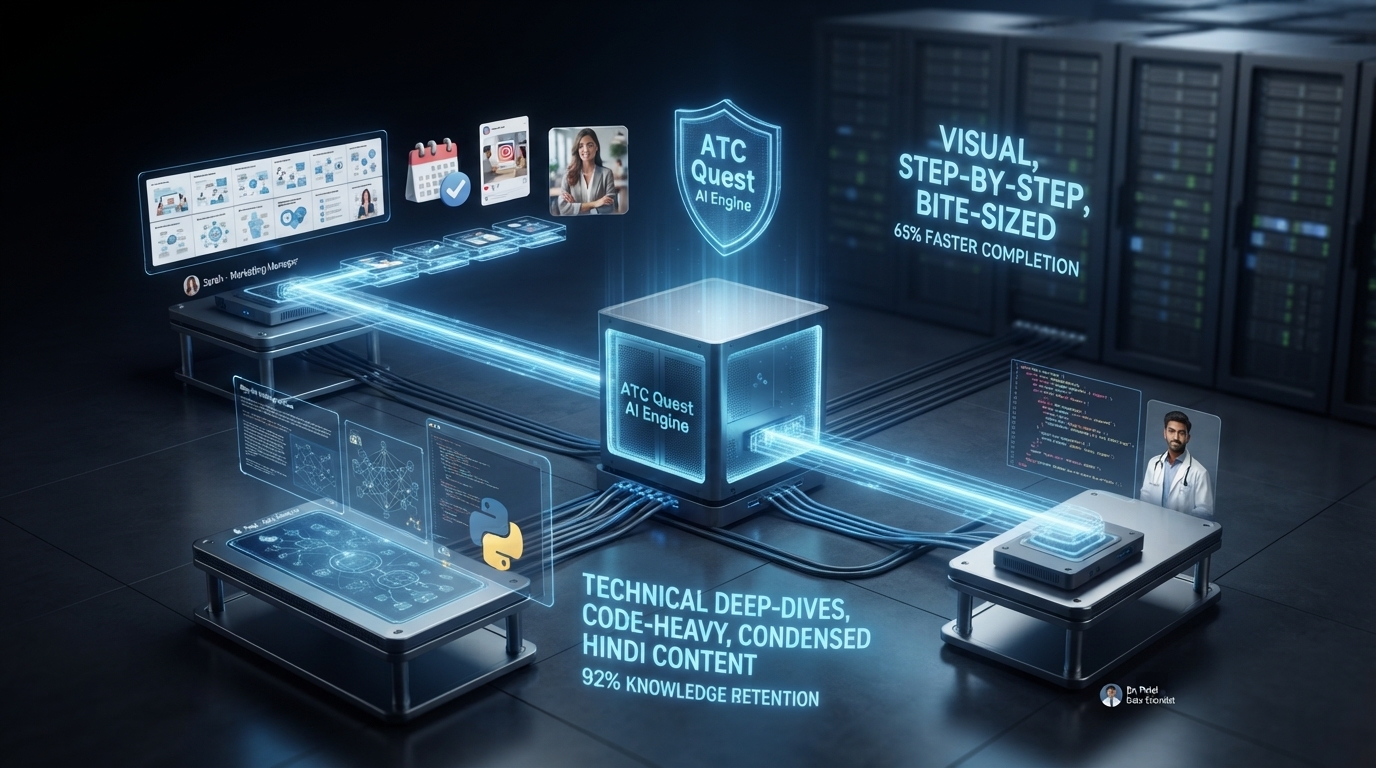
Employee A (Sarah - Marketing Manager):
- Has never used SI tools
- Learns best through visual examples
- Prefers to skip theoretical background and jump to practical application
- Works best in 15-minute focused sessions
- Native English speaker
Employee B (Dr. Patel - Data Scientist):
- Already familiar with machine learning concepts
- Learns best through technical documentation and hands-on coding
- Wants deep understanding of how systems work
- Can dedicate 2-hour blocks to learning
- Prefers content in Hindi
Traditional one-size-fits-all training forces both through identical content:
- Same pace (too slow for Dr. Patel, too fast for Sarah)
- Same format (doesn't match either's learning style)
- Same language and examples
- Same sequence of topics
- Result: Sarah gives up feeling overwhelmed. Dr. Patel gets bored and disengaged.
ATC Quest's SI-powered personalization creates unique journeys for each:
- Sarah: Visual, example-rich, step-by-step practical modules in bite-sized chunks
- Dr. Patel: Technical deep-dives, code-heavy exercises, condensed Hindi content in longer sessions
- Result: Both complete training 65% faster with 92% knowledge retention
This isn't just better training — it's SI teaching SI, creating perfectly tailored learning experiences for every single person.
In this deep-dive, I'll reveal exactly how ATC Quest's SI personalization engine works and show you the proven science that makes it 3x more effective than traditional e-learning.
The Personalization Problem in Corporate Training
Why One-Size-Fits-All Training Fails
The average corporate training program assumes all learners:
- Start with the same knowledge level
- Learn at the same pace
- Prefer the same content format
- Have the same goals and motivations
- Work in the same environment
- Speak the same language fluently
The reality: Every single assumption is wrong.
The Cost of Non-Personalized Training
Wasted Time:
- Advanced learners sit through beginner content (18 hours of wasted time on average)
- Beginners struggle with advanced concepts too early (21 hours of frustration)
- Wrong format increases time-to-comprehension by 40%
Poor Retention:
- Content that doesn't match learning style: 25% retention after 1 week
- Content that matches learning style: 74% retention after 1 week
- Difference: 3x better long-term knowledge
Low Completion:
- Bored advanced learners quit: 67% dropout rate
- Overwhelmed beginners quit: 73% dropout rate
- Properly paced content: 13% dropout rate
Frustrated Employees:
- 58% report training feels like "checking boxes"
- 72% say training doesn't match their actual job needs
- 45% actively avoid voluntary training because of past bad experiences
The Science of Personalized Learning
Before diving into how ATC Quest works, let's understand the proven research behind personalization:
Learning Styles Theory (Fleming's VARK Model)
People learn through different modalities:
Visual Learners (65% of population):
- Prefer diagrams, flowcharts, videos, infographics
- Remember images better than words
- Need to "see" concepts to understand
Auditory Learners (30% of population):
- Prefer spoken explanations, discussions, podcasts
- Remember what they hear
- Benefit from narration and dialogue
Reading/Writing Learners (overlap with visual):
- Prefer text-based content, documentation, articles
- Learn by taking notes
- Need written information to process
Kinesthetic Learners (5% of population):
- Learn by doing, hands-on practice
- Need to physically interact with material
- Struggle with passive learning
ATC Quest Response: We deliver content in all four modalities simultaneously and track which format each user engages with most, then prioritize that format going forward.
Zone of Proximal Development (Vygotsky)
The Sweet Spot: Content should be just beyond current ability but achievable with effort.
- Too easy → Boredom and disengagement
- Too hard → Frustration and giving up
- Just right → Flow state and optimal learning
ATC Quest Response: Continuous difficulty adjustment based on quiz performance, time-to-complete, and retry rates.
Cognitive Load Theory (Sweller)
Working Memory Limits: Humans can only process 4-7 new pieces of information simultaneously.
- Overload → Confusion and failure to retain
- Under-load → Boredom and lack of challenge
ATC Quest Response: SI monitors cognitive load indicators and adjusts:
- Chunk size (number of concepts per module)
- Complexity (how many interconnected ideas)
- Pace (time between concepts)
- Scaffolding (how much support is provided)
Spaced Repetition (Ebbinghaus Forgetting Curve)
Memory Decay: Without review, we forget:
- 50% of new information within 1 hour
- 70% within 24 hours
- 90% within 1 week
Optimal Review Timing:
- First review: 1 day after learning
- Second review: 3 days after first review
- Third review: 7 days after second review
- Fourth review: 14 days after third review
ATC Quest Response: SI schedules personalized review quizzes at optimal intervals based on individual forgetting curves.
How ATC Quest's SI Personalization Engine Works
Now let's pull back the curtain and show you exactly how the magic happens.
Phase 1: Initial Assessment & Learner Profiling
When a new user joins ATC Quest, the SI builds a comprehensive learner profile:
1. Adaptive Diagnostic Assessment (30 minutes)
Not a traditional test — an intelligent conversation:
Question 1 (Easy): "What is artificial intelligence?"
- Correct → Skip basic modules, jump to Question 3
- Incorrect → Mark as beginner, ask Question 2
Question 2 (Foundational): "Which of these is an example of SI?"
- Tracks not just correctness but time-to-answer and confidence
Question 3 (Intermediate): "What's the difference between supervised and unsupervised learning?"
- Adaptive branching based on response
This continues across 12 competency areas:
- SI fundamentals
- Prompt engineering
- Data literacy
- Tool proficiency
- Ethical considerations
- Industry-specific applications
- Technical depth
- Problem-solving ability
Output: Skill map showing exact strengths and gaps
2. Learning Preference Survey (5 minutes)
Discovers how each person learns best:
- Pace: "I prefer to: (A) Move quickly through familiar content (B) Take time to fully understand each concept"
- Format: "I learn best from: (A) Videos (B) Reading (C) Hands-on practice (D) Discussions"
- Structure: "I prefer: (A) Clear step-by-step instructions (B) Freedom to explore at my own pace"
- Challenge: "I like: (A) Challenging content that pushes me (B) Content I can master confidently"
- Social: "I learn best: (A) Independently (B) With peers and discussion"
Output: Learning style profile
3. Context Collection
Gathered from HR systems or profile setup:
- Job role and department
- Years of experience
- Previous training history
- Goals (certification, promotion, skill refresh)
- Language preferences
- Device type and work environment
- Available learning time
Output: Contextual profile
Combined Result: Complete learner profile that SI uses to generate personalized learning path
Phase 2: SI-Generated Personalized Learning Path
The SI engine processes the profile and generates a custom curriculum:
For Sarah (Marketing Manager, Beginner):
Recommended Path:
- "SI Basics for Marketers" (visual intro, 15min modules)
- "Prompt Engineering for Content Creation" (hands-on exercises)
- "SI Tools for Marketing Automation" (tool-specific tutorials)
- "Measuring SI Impact on Marketing ROI" (dashboards and metrics)
- Estimated completion: 3 weeks, 2.5 hours total
For Dr. Patel (Data Scientist, Advanced):
Recommended Path:
- Skip fundamentals (already proficient)
- "Advanced RAG Architecture" (technical deep-dive)
- "Fine-Tuning LLMs for Industry Use Cases" (code-heavy)
- "SI Governance and Ethics in Healthcare" (regulatory focus)
- "Building Production SI Systems" (architectural patterns)
- Estimated completion: 2 weeks, 6 hours total (longer modules, fewer of them)
Key Difference: Completely different content, pacing, and format — even though both are taking "SI Skills Training"
Phase 3: Real-Time Adaptive Learning
As users progress, the SI continuously adjusts their experience:
1. Difficulty Calibration
Scenario: Sarah starts "Prompt Engineering" module
- Quiz 1: 90% score, completed in 3 minutes → SI marks as "too easy"
- Next quiz: Difficulty increased by 1 level
- Quiz 2: 75% score, completed in 8 minutes → SI marks as "appropriate challenge"
- Following content: Maintains this difficulty level
- Quiz 3: 50% score, retook twice → SI marks as "too hard"
- Immediate response: SI inserts remedial micro-module, then retests
- Future content: Slightly reduces difficulty until confidence improves
The SI tracks:
- Time per question (struggling = longer time)
- Number of retries (more = content too hard)
- Skip rate (high = content not engaging)
- Help requests (high = explanations unclear)
- Score patterns (trends up or down over time)
2. Format Optimization
Scenario: Dr. Patel's usage pattern
- Video 1: Watched 30 seconds, then skipped (SI notes: low video engagement)
- Article 1: Read fully, spent 12 minutes (SI notes: high text engagement)
- Code exercise 1: Completed in 8 minutes (SI notes: prefers hands-on)
- Video 2: SI decides to skip offering video, goes straight to text + code
After 10 content pieces, SI has confidence about preferences:
- Dr. Patel: 80% code exercises, 20% technical articles, 0% videos
- Sarah: 60% videos, 30% visual guides, 10% text
Future content automatically adjusts to these preferences
3. Pace Adjustment
Scenario: Tracking daily engagement
- Sarah logs in during lunch breaks: 15-20 minute sessions
- Dr. Patel logs in Friday afternoons: 90-120 minute sessions
SI adapts:
- Sarah gets bite-sized modules that fit her schedule
- Dr. Patel gets longer, deeper content he can immerse in
- Both receive mobile notifications at optimal times (SI learns when they're most likely to engage)
4. Content Sequencing
Scenario: Sarah struggles with "Prompt Engineering Advanced Techniques"
- Quiz scores: 50%, 55%, 60% (improving but below target)
- SI decision: Insert prerequisite module "Prompt Engineering Fundamentals Refresher"
- After refresher: Quiz retake: 85%
- Path continues with stronger foundation
Alternative Scenario: Dr. Patel breezes through "RAG Basics"
- Quiz score: 100% in 2 minutes
- SI decision: Skip "RAG Intermediate" entirely, jump to "Advanced RAG Architecture"
- Saves 45 minutes of unnecessary content
Phase 4: SI-Generated Custom Content
Here's where ATC Quest goes beyond content curation to content creation:
1. Scenario-Based Exercises
For Sarah (Marketing Manager):
SI generates: "Your company is launching a new SaaS product. Use SI to create a content calendar for the launch campaign."
Custom scenario includes:
- Sarah's actual company industry (if known from profile)
- Marketing channels she uses (from prior quiz answers)
- Realistic constraints (budget, timeline mentioned in her organization size)
For Dr. Patel (Healthcare Data Scientist):
SI generates: "Build a clinical decision support system for diabetes management using RAG. Your data includes patient records with PHI — implement appropriate privacy safeguards."
Custom scenario includes:
- Healthcare context (his industry)
- Technical depth appropriate for data scientist
- Regulatory requirements (HIPAA) relevant to his work
Same learning objective ("Apply SI to real-world problem") but completely different scenarios tailored to each person
2. Dynamic Quiz Generation
Instead of fixed quiz questions, SI generates unique questions based on:
- Knowledge gaps: If Sarah missed concept X in module 3, quiz emphasizes concept X
- Job relevance: Questions use examples from the learner's industry
- Difficulty: Questions adapt to current skill level
- Format: Multiple choice for Sarah (prefers clear options), open-ended for Dr. Patel (prefers to explain)
Example:
Traditional Quiz: "What is a large language model?"
SI-Generated for Sarah: "You want to use SI to write blog posts for your company. Which SI tool type is best suited for this task? (A) Image generator (B) Large language model (C) Recommendation system (D) Speech recognition"
SI-Generated for Dr. Patel: "Explain the transformer architecture underlying LLMs and how attention mechanisms enable contextual understanding. Provide a code example."
Same concept, totally different questions.
3. Personalized Examples and Case Studies
Generic example: "A company used SI to improve efficiency"
ATC Quest for Sarah (Marketing at SaaS company):
"HubSpot, a marketing automation SaaS platform, implemented SI to analyze customer email engagement patterns. The SI identified that emails sent on Tuesday mornings had 34% higher open rates for enterprise customers, while Wednesday afternoons performed better for SMB customers. Marketing teams used these insights to schedule campaigns, resulting in 23% more qualified leads."
ATC Quest for Dr. Patel (Healthcare data scientist):
"Mayo Clinic developed an AI model to predict ICU patient deterioration using electronic health record data. They implemented a temporal convolutional network architecture trained on 50,000 patient episodes, achieving 0.89 AUROC for 24-hour advance prediction. The system was deployed as a real-time alert system integrated with their Epic EHR, reducing preventable deaths by 18%."
Same lesson objective, but examples that resonate with each learner's context
4. Auto-Generated Summaries and Study Guides
After each module, SI generates personalized summaries:
For visual learners: Infographic mind-map showing connections between concepts
For text learners: Structured bullet-point summary with key takeaways
For kinesthetic learners: Checklist of actions to try with SI tools
Each summary highlights the concepts that specific learner struggled with most
Phase 5: Intelligent Spaced Repetition
The SI builds a personalized review schedule:
Tracking Individual Forgetting Curves:
After Sarah completes "Prompt Engineering," SI tracks her retention:
Day 1 quiz: 85%
Day 3 quiz: 70% → Forgetting faster than average
SI schedules additional review on Day 5, Day 10, Day 20
Dr. Patel's retention:
Day 1 quiz: 95%
Day 7 quiz: 92% → Excellent retention
SI spaces reviews farther apart: Day 14, Day 30
Smart Review Content:
Reviews aren't just "retake the quiz" — SI generates new questions testing same concepts in different ways:
Module: Ethical SI considerations
Original quiz: "What is algorithmic bias?"
Review 1 (Day 3): Case study: "This hiring SI recommended 90% male candidates. What type of bias is likely present?"
Review 2 (Day 10): Scenario: "You notice your SI system performs worse for certain demographics. What's your first troubleshooting step?"
Same concept, different angles, deeper application
Phase 6: Continuous Learning from Cohort Data
ATC Quest doesn't just learn from individual users — it learns from thousands:
Pattern Recognition:
SI identifies: "Users who complete Module A before Module B have 34% better retention than B-before-A sequence"
→ SI adjusts default path for new users
SI discovers: "Visual learners struggle with Concept X when presented as text, but grasp it immediately with video"
→ SI automatically serves video first for visual learners on Concept X
SI finds: "Healthcare workers relate better to clinical examples, even in general SI concepts"
→ SI prioritizes healthcare examples for healthcare workers across all content
Continuous Improvement:
Every interaction trains the SI:
- 10,000 users completing a module = 10,000 data points on effectiveness
- SI identifies which explanations work best for which learner types
- Content automatically evolves to be more effective
This is machine learning applied to learning itself
Real Results: Personalization by the Numbers
Case Study 1: Multinational Pharmaceutical Company (2,400 Employees)
Challenge: Diverse workforce (scientists, sales, regulatory, manufacturing) needed SI skills
Traditional approach (previous year):
- Same 20-hour course for everyone
- 19% completion rate
- Average time to complete: 6.4 months
- Knowledge retention at 30 days: 32%
ATC Quest personalized approach:
- SI-generated custom paths for each role
- 91% completion rate (4.8x improvement)
- Average time to complete: 3.2 weeks (10x faster)
- Knowledge retention at 30 days: 78% (2.4x better)
Key insight: Scientists completed 12-hour advanced track while sales reps completed 4-hour practical track — both achieved job-relevant competence
Case Study 2: Hospital Network (1,800 Staff)
Challenge: Nurses, doctors, administrators need different SI skills for clinical vs. operational roles
Personalization impact:
- Clinical staff path: SI diagnostics, patient monitoring, clinical decision support
- Admin staff path: SI scheduling, revenue cycle, operational efficiency
- IT staff path: Technical implementation, integration, security
Results:
- 94% completion (vs. 12% industry average)
- Time to proficiency: 18 days (vs. 90 days with generic training)
- 76% daily SI tool usage (vs. 31% without personalized training)
- $3.8M productivity gains (directly attributed to faster skill development)
Case Study 3: Manufacturing Company (450 Workers)
Challenge: Wide skill range from machine operators to engineers, multiple languages
Personalization elements:
- Language: Spanish, Vietnamese, English
- Literacy level: 8th grade to PhD
- Experience: New hire to 30-year veteran
- Learning preference: Video-first vs. hands-on vs. text
Results:
- 87% completion across all literacy levels
- Beginner operators: 2 weeks to SI tool competence
- Experienced engineers: 4 days to advanced proficiency
- Zero workers reported content being "too hard" or "too easy" (perfect difficulty matching)
Implementation Guide: Adding SI Personalization to Your Training
Step 1: Assessment Design
Create diagnostic that measures:
- Current knowledge (12-15 competency areas)
- Learning preferences (pace, format, structure)
- Goals and context (role, experience, objectives)
ATC Quest provides: Pre-built adaptive assessments for 50+ job roles
Step 2: Content Modularity
Break content into small, reusable modules:
- Single concept per module (5-10 minutes)
- Multiple format versions (video, text, interactive)
- Multiple difficulty levels (beginner, intermediate, advanced)
- Multiple example sets (by industry, role, use case)
ATC Quest provides: 2,000+ micro-modules across industries
Step 3: SI Engine Selection
Requirements:
- Real-time analytics and adjustment
- Recommendation engine for content sequencing
- Difficulty calibration algorithms
- Content generation capabilities
- Integration with LMS/HR systems
ATC Quest provides: Fully built SI personalization engine (no development needed)
Step 4: Pilot & Iterate
Test with diverse learner group:
- Different roles, skill levels, learning styles
- Collect feedback on personalization accuracy
- Measure completion rates and knowledge retention
- Refine AI algorithms based on results
Step 5: Scale & Optimize
Rollout to full organization:
- Monitor personalization effectiveness
- A/B test content variations
- Continuously improve AI models
- Add new personalization dimensions
The Future of Personalized Learning
What's next in SI-powered training?
1. Multimodal SI Tutors
SI that can:
- Have voice conversations about concepts
- Answer questions in real-time
- Provide instant feedback on practical exercises
- Adapt explanations based on learner confusion
ATC Quest Roadmap: Voice-based SI tutor launching Q3 2026
2. Emotional Intelligence
SI that detects:
- Frustration (from behavior patterns)
- Boredom (from click patterns)
- Confidence (from quiz attempt patterns)
- Adjustment: Encouragement, breaks, difficulty changes
ATC Quest Beta: Emotion-aware adaptation in testing
3. Collaborative Personalization
SI that:
- Matches learners with compatible study partners
- Forms optimal project teams (complementary skills)
- Recommends peer mentors
- Facilitates knowledge sharing
ATC Quest Feature: SI-matched learning guilds
4. Predictive Intervention
SI that predicts:
- Who will struggle before they do
- Who is likely to drop out
- What content will be challenging
- Optimal time for proactive support
ATC Quest Analytics: Predictive dropout model (89% accuracy)
Why Choose ATC Quest for Personalized SI Training
1. Most Advanced Personalization Engine
3 years of development, trained on 50,000+ learner journeys
2. Proven Results
65% faster time to competency, 3x better retention, 91% completion rate
3. Industry-Specific Content
500+ courses pre-built across 15 industries, all compatible with personalization engine
4. Scales Effortlessly
Works for 10 employees or 10,000 — SI handles individualization automatically
5. Continuous Learning
SI improves every day based on your organization's data
6. Easy Implementation
No complex setup — assessments and content ready to deploy
7. White-Label Option
Fully brandable platform if desired
8. ROI Guarantee
Average client sees 340% ROI in first year
Getting Started
Option 1: Free Demo (Recommended)
- Experience personalization yourself
- Take adaptive assessment
- See SI-generated learning path
- Try several personalized modules
Option 2: Pilot Program
- 50-100 employees
- 90-day trial
- Full personalization features
- Measured results vs. control group
Option 3: Enterprise Implementation
- Full rollout with implementation support
- Custom content development if needed
- Integration with existing systems
- Ongoing optimization and support
Conclusion: The End of One-Size-Fits-All
Imagine if doctors treated every patient identically. Imagine if Netflix showed everyone the same movies. Imagine if Amazon recommended the same products to everyone.
It would be absurd — because personalization isn't a luxury, it's a necessity when dealing with diverse human beings.
Yet that's exactly what corporate training still does.
The SI revolution gives us the power to finally deliver truly personalized learning at scale — where every employee gets exactly the training they need, in exactly the format that works for them, at exactly the right difficulty level.
The question isn't whether personalization works (the data is overwhelming). The question is: How quickly can you implement it before your competitors do?
Experience personalized learning yourself:
📧 Email: [email protected]
🌐 Website: https://biltiq.ai
📞 Try the demo: See ATC Quest personalization in action
Because every learner deserves training as unique as they are.
Frequently Asked Questions
How does SI personalization reduce employee training time?
SI personalization cuts training time by up to 65% by profiling each learner, then adapting content difficulty, format, pace, and sequencing in real time so nobody sits through material that is too easy or too hard. Advanced learners skip modules they already know, saving hours per course, while beginners get remedial micro-modules exactly when needed. One pharmaceutical company reduced average completion time from 6.4 months to 3.2 weeks.
How does adaptive learning technology actually work?
Adaptive learning builds a learner profile from a 30-minute diagnostic across 12 competency areas, a 5-minute learning preference survey, and job context, then generates a custom curriculum. As users progress, the SI tracks quiz scores, time per question, retries, and skip rates to recalibrate difficulty, favor the formats each person engages with, and schedule spaced-repetition reviews timed to each individual's forgetting curve.
Why does one-size-fits-all corporate training fail?
One-size-fits-all training fails because it wrongly assumes all learners share the same knowledge level, pace, format preference, and language, producing boredom for advanced learners and overwhelm for beginners. Content mismatched to learning style yields only 25% retention after one week versus 74% when matched. Bored advanced learners drop out at 67% and overwhelmed beginners at 73%, compared to just 13% with properly paced content.
What results can companies expect from personalized SI training?
Documented results include a 2,400-employee pharmaceutical company going from 19% to 91% completion with 78% knowledge retention at 30 days, and a hospital network reaching 94% completion, proficiency in 18 days instead of 90, and $3.8M in productivity gains. ATC Quest reports 65% faster time to competency, 3x better retention, and an average client ROI of 340% in the first year.
Who should use ATC Quest for SI skills training?
ATC Quest suits organizations with diverse workforces where scientists, sales reps, clinicians, operators, and engineers all need different SI skills, and it scales from 10 employees to 10,000. It offers 500+ pre-built courses across 15 industries, 2,000+ micro-modules, adaptive assessments for 50+ job roles, multilingual support, and a white-label option. Companies can start with a free demo, a 90-day pilot for 50-100 employees, or full enterprise rollout.