
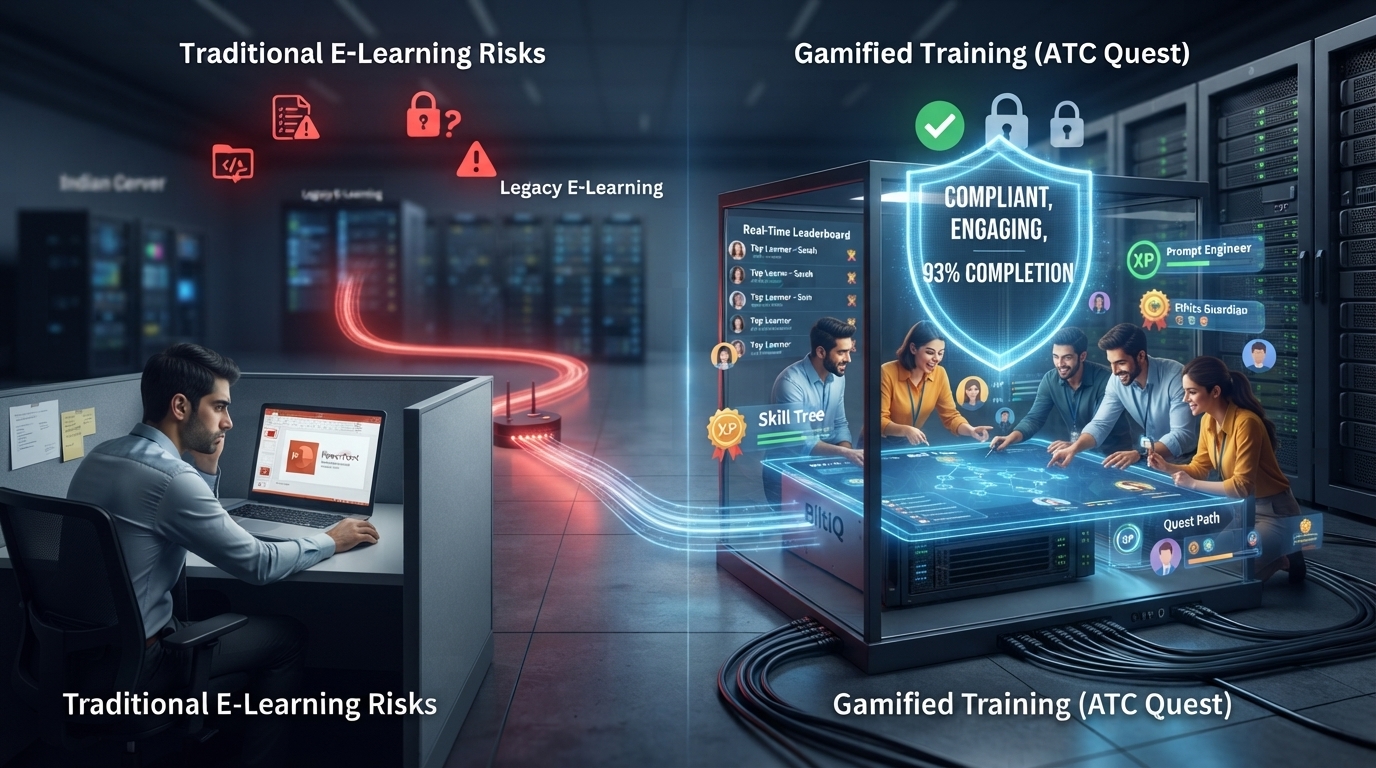
Here's a sobering statistic: The average e-learning course completion rate is just 12%.
Let that sink in. For every 100 employees you enroll in traditional online training, only 12 will actually finish it. That's 88% of your training budget literally going to waste.
But what if I told you there's a proven method that flips this equation on its head — achieving completion rates of 93% or higher? And no, it doesn't involve mandatory training sessions or threatening job reviews.
The secret? Gamification.
At BiltIQ, our ATC Quest platform leverages advanced gamification mechanics to transform boring compliance training and complex SI skill-building into engaging quests that employees actually want to complete. In this comprehensive guide, I'll show you exactly how we do it — and how you can apply these principles to your training programs.
The Training Completion Crisis: Why Traditional E-Learning Fails
Before we dive into solutions, let's understand why traditional e-learning has such abysmal completion rates.
The Four Horsemen of Training Abandonment
1. Lack of Motivation
- No immediate consequences for not completing
- Benefits feel abstract or distant
- Content feels irrelevant to daily work
- No social accountability or peer pressure
2. Boredom and Disengagement
- Death by PowerPoint slides
- Monotonous narration with no interaction
- No variety in content delivery
- Linear, predictable structure
3. No Sense of Progress
- Can't see how far they've come or how much remains
- No intermediate milestones or achievements
- All-or-nothing completion model
- No visible skill progression
4. Poor Learning Design
- Information dumping without application
- No feedback loops
- No immediate practice opportunities
- One-size-fits-all approach
The Cost of Low Completion Rates
Low training completion isn't just embarrassing — it's expensive:
- Wasted Budget: $70B spent annually on corporate training with minimal ROI
- Skill Gaps: Employees lack critical skills because they didn't complete training
- Compliance Risks: Incomplete compliance training exposes organizations to legal liability
- Low Morale: Forced but ineffective training frustrates employees
- Competitive Disadvantage: Slower skill development than competitors
Enter Gamification: The Science of Engagement
Gamification isn't about making learning "fun" with badges and points. It's about applying game design principles to tap into fundamental human psychology.
The Psychology Behind Gamification
Intrinsic Motivation Drivers (Self-Determination Theory):
- Autonomy: People want control over their choices and actions
- Competence: People want to feel capable and see themselves improving
- Relatedness: People want to connect with others and feel part of a community
Behavioral Triggers (Hooked Model):
- Trigger: Something prompts action (internal motivation or external cue)
- Action: User takes simple action expecting reward
- Variable Reward: Unexpected rewards create dopamine spikes
- Investment: User invests time/effort, increasing commitment
Flow State (Mihaly Csikszentmihalyi):
- Perfect balance between challenge and skill
- Clear goals and immediate feedback
- Complete focus and absorption in activity
- Time flies; work feels effortless
When you design learning experiences that activate these psychological principles, engagement skyrockets.
The ATC Quest Gamification Framework: 8 Core Mechanics
Here's exactly how we've built ATC Quest to achieve 93%+ completion rates:
1. XP (Experience Points) and Leveling System
How It Works:
Employees earn XP for every learning activity:
- Completing a module: 100-500 XP (based on difficulty)
- Passing a quiz: 50-200 XP (based on score)
- Watching a video: 25-100 XP
- Completing a hands-on exercise: 200-1000 XP
- Helping a peer: 50-150 XP
- Daily login streak: 10 XP per day
As XP accumulates, learners level up:
- Level 1-5: Novice (SI Curious)
- Level 6-10: Apprentice (SI Explorer)
- Level 11-20: Professional (SI Practitioner)
- Level 21-30: Expert (SI Specialist)
- Level 31-50: Master (SI Champion)
Why It Works:
- Visible Progress: XP bars show constant advancement, even in small increments
- Clear Milestones: Levels provide medium-term goals that feel achievable
- Status: Higher levels signal expertise to peers and managers
- Momentum: The desire to "level up" drives continued engagement
Real Impact:
A healthcare organization using ATC Quest reported that 78% of employees logged in daily to maintain their XP streaks, even on weekends. This daily engagement led to 5.2x faster skill acquisition.
2. Achievement Badges and Certifications
How It Works:
We've designed 150+ unique badges across categories:
Skill Mastery Badges:
- Prompt Engineering Pro
- RAG System Architect
- SI Ethics Guardian
- Data Wizard
- Automation Expert
Behavioral Badges:
- Early Bird (complete training before deadlines)
- Speed Demon (complete modules quickly)
- Perfectionist (score 100% on quizzes)
- Helping Hand (assist 10+ peers)
- Comeback Kid (complete after previous abandonment)
Milestone Badges:
- First Quest Completed
- 10-Day Streak
- 100 Modules Completed
- Department Champion
- Company Legend
Special Event Badges:
- SI Skills Week Participant
- Hackathon Winner
- Innovation Challenge Finalist
Why It Works:
- Collection Motivation: People love completing sets and collecting rare items
- Social Proof: Badges displayed on profiles signal accomplishment
- Bragging Rights: Unique badges become status symbols
- Goal Diversity: Multiple achievement paths accommodate different preferences
Real Impact:
When we introduced the "Department Champion" badge (top scorer in your department), completion rates increased by 34% as employees competed for departmental pride.
3. Leaderboards and Social Competition
How It Works:
Multiple leaderboards create healthy competition:
Global Leaderboard:
- Top 100 learners company-wide
- Updated in real-time
- Viewable by all employees
Department Leaderboards:
- Compete with peers in same function
- Visible to department only
- Fosters team identity
Role-Based Leaderboards:
- Nurses vs. nurses, engineers vs. engineers
- Fair competition among similar roles
- Highlights top performers in each role
Team Challenges:
- Departments compete against each other
- Collaborative scoring (team total XP)
- Special team-based rewards
Time-Bound Competitions:
- Weekly sprints
- Monthly championships
- Quarterly tournaments
Why It Works:
- Social Comparison: Humans naturally compare themselves to others
- Competitive Drive: Competition motivates higher effort
- Recognition: Top performers gain visibility and respect
- Belonging: Team competitions build camaraderie
Critical Design Element: We include both competitive AND collaborative elements. Leaderboards satisfy competitive personalities, while team challenges engage those motivated by cooperation.
Real Impact:
A manufacturing company ran a "Plant vs. Plant" team challenge. The resulting friendly rivalry led to 89% completion across all plants in just 3 weeks — with employees voluntarily working on training during lunch breaks.
4. Quest-Based Learning Paths
How It Works:
Instead of "courses," employees embark on "quests":
Main Quests (Core Learning Path):
- "Journey to SI Mastery" (foundational SI skills)
- "The Clinical SI Expedition" (healthcare-specific)
- "Manufacturing Revolution Quest" (industrial SI)
Each main quest has 10-15 chapters, presented as a narrative journey.
Side Quests (Optional Deep Dives):
- "Master the Art of Prompt Engineering"
- "Ethical SI: Guardian Training"
- "Advanced RAG Systems Workshop"
Side quests let learners explore interests beyond required training.
Daily Quests (Micro-Learning):
- 5-10 minute activities
- New quest each day
- Bonus XP for completion
- Builds daily habit
Epic Quests (Long-Term Projects):
- Apply learning to real business challenge
- 4-8 week duration
- Requires multiple skills
- Massive XP rewards and special recognition
Why It Works:
- Narrative Engagement: Stories make learning memorable
- Clear Direction: Quest structure provides obvious next steps
- Variety: Mix of required and optional content
- Epic Meaning: Connection to larger purpose
Real Impact:
We transformed a 40-hour "SI Fundamentals Course" into "The SI Hero's Journey" quest. Completion time dropped from 6 months to 3 weeks, with 91% completion rate.
5. Skill Trees and Progressive Unlocking
How It Works:
Visual skill tree shows:
- Current position in learning journey
- Available next steps
- Locked advanced content
- Prerequisites for unlocking
Example Skill Tree (SI for Healthcare):
                SI Healthcare Master
                        |
                _______________
               |               |
        Clinical SI        Admin SI
            |                  |
    _____________        _____________
   |             |      |             |
Diagnosis Treatment Scheduling Billing
Support Plans Optimization Automation
|
| |
Imaging Labs
SI SI
Content unlocks progressively:
- Complete "Imaging SI" to unlock "Labs SI"
- Complete both to unlock "Diagnosis Support"
- Complete all branches to unlock "SI Healthcare Master"
Why It Works:
- Anticipation: Locked content creates curiosity
- Achievement: Unlocking new content feels rewarding
- Structure: Visual map prevents overwhelm
- Mastery Path: Clear progression from novice to expert
Real Impact:
By showing locked "Expert" content from the start, we created aspirational motivation. 67% of learners completed optional intermediate modules just to unlock advanced content they were curious about.
6. Real-Time Feedback and Instant Rewards
How It Works:
Immediate feedback after every action:
Visual Celebrations:
- XP counter animation ("+250 XP!")
- Level-up fanfare with confetti
- Badge unlock animation with sound
- Progress bar fills with satisfying animation
- Streak counter increments
Performance Feedback:
- Quiz results immediately after submission
- Explanation of correct/incorrect answers
- Suggested resources for improvement
- Benchmarking against peers
Encouragement Messages:
- "Great job! You're in the top 10% for this module!"
- "Nice streak! You've logged in 7 days straight!"
- "You're almost there! One more module to level up!"
Why It Works:
- Dopamine Hits: Immediate rewards trigger pleasure response
- Behavior Reinforcement: Instant feedback strengthens desired behaviors
- Motivation Maintenance: Regular small wins prevent discouragement
- Clarity: Learners know exactly how they're performing
Real Impact:
A/B testing showed that immediate XP animations increased module completion by 23% compared to delayed batch updates.
7. Streaks and Habit Formation
How It Works:
- Track consecutive days of learning activity
- Display current streak prominently
- Celebrate milestone streaks (7, 30, 100 days)
- "Freeze" option to save streak during emergencies (limited use)
- Streak leaderboard for longest active streaks
Streak Rewards:
- 7 days: 500 bonus XP
- 30 days: Special "Dedicated Learner" badge
- 100 days: "Learning Legend" badge + certificate
- 365 days: Lifetime achievement recognition
Why It Works:
- Loss Aversion: People hate breaking streaks more than they love starting them
- Habit Formation: Daily action becomes automatic after 21-30 days
- Commitment: Longer streaks increase psychological investment
- Social Pressure: Visible streaks create accountability
Real Impact:
After implementing streaks, daily active users increased by 340%. Average time between logins dropped from 8.3 days to 1.2 days.
8. Collaborative Challenges and Guild System
How It Works:
Guilds (Learning Teams):
- Employees join or create guilds (max 25 members)
- Guilds have names, logos, and team pages
- Guild XP = sum of member XP
- Guild leaderboards and competitions
Collaborative Challenges:
- Guild vs. Guild competitions
- Cooperative quests requiring teamwork
- Shared goals (e.g., "Guild completes 500 modules this month")
- Team-based rewards
Peer Learning Features:
- Discussion forums within guilds
- Peer mentoring assignments
- Collaborative projects
- Knowledge sharing rewards
Why It Works:
- Accountability: Don't want to let teammates down
- Support: Struggling learners get help from peers
- Motivation Transfer: Enthusiastic members inspire others
- Belonging: Guild membership creates community
Real Impact:
Employees in guilds had 2.7x higher completion rates than solo learners. Peer-to-peer help reduced support tickets by 58%.
Implementation Guide: How to Gamify Your Training Program
Want to implement these gamification mechanics in your organization? Here's our proven playbook:
Phase 1: Foundation (Weeks 1-2)
1. Define Learning Objectives
- What skills/knowledge must employees acquire?
- What behaviors do you want to encourage?
- What does success look like?
2. Identify Learner Motivations
- Survey employees about what motivates them
- Understand your audience demographics
- Identify preferred game mechanics
3. Choose Your Platform
- Custom development (most flexible, most expensive)
- Learning platform with gamification (like ATC Quest)
- Plugin/overlay for existing LMS
4. Design Your Reward System
- Define XP values for each activity
- Create level progression structure
- Design badge/achievement system
- Plan leaderboard categories
Phase 2: Content Development (Weeks 3-6)
1. Transform Content into Quests
- Break courses into bite-sized missions
- Add narrative framing and context
- Create clear objectives for each quest
- Design varied content types
2. Build Assessment Challenges
- Transform tests into challenge battles
- Add immediate feedback mechanisms
- Create multiple difficulty levels
- Include both knowledge and application
3. Develop Social Features
- Create discussion spaces
- Design collaborative challenges
- Build peer review systems
- Plan team competitions
Phase 3: Beta Launch (Weeks 7-8)
1. Select Beta Group
- 10-15% of total user base
- Mix of enthusiasts and skeptics
- Representative of different departments/roles
2. Collect Feedback
- Which features drive engagement?
- What's confusing or frustrating?
- What additional features do users want?
- Technical issues and bugs
3. Iterate Rapidly
- Fix critical bugs immediately
- Adjust difficulty/rewards based on data
- Add highly requested features
- Refine based on usage patterns
Phase 4: Full Rollout (Weeks 9-12)
1. Launch Campaign
- Executive endorsement and participation
- Communication about benefits
- Tutorial content and support
- Kickoff event/competition
2. Ongoing Engagement
- Weekly challenges and events
- Monthly tournaments
- New content and quests
- Regular rewards and recognition
3. Measure and Optimize
- Track completion rates
- Monitor engagement metrics
- A/B test features
- Continuously improve
Common Gamification Mistakes to Avoid
Mistake #1: Points Without Purpose
The Error: Adding XP and badges without connecting them to real value.
The Fix: Ensure points lead to meaningful rewards (recognition, career advancement, monetary incentives).
Mistake #2: Ignoring Different Player Types
The Error: Designing only for competitive achievers.
The Fix: Include mechanics for all player types:
- Achievers: Leaderboards, high scores, difficult challenges
- Explorers: Hidden content, discovery rewards, varied paths
- Socializers: Team challenges, discussion forums, peer recognition
- Philanthropists: Helping peers, mentoring, contributing content
Mistake #3: Over-Gamification
The Error: So many game mechanics that learning becomes secondary.
The Fix: Game elements should enhance, not overshadow, learning objectives.
Mistake #4: No Stakes
The Error: Completion is purely optional with no consequences.
The Fix: Tie gamified learning to performance reviews, certifications, or job requirements.
Mistake #5: Static Content
The Error: Same quests and challenges forever.
The Fix: Regular updates with new content, seasonal events, and evolving challenges.
ATC Quest: Gamification Built for Results
At BiltIQ, we've spent three years perfecting gamification for SI skills training. ATC Quest delivers:
Proven Completion Rates:
- 93% average course completion
- 650% higher than traditional e-learning
- 74% better knowledge retention
Engagement Metrics:
- 4.2 logins per week (vs. 0.8 industry average)
- 87% of users return within 48 hours
- Average session time: 32 minutes
Business Impact:
- 3x faster skill acquisition
- 58% reduction in training support costs
- 340% increase in voluntary learning
Industry-Specific Content:
- 500+ courses across 15 industries
- Role-specific quests for 200+ job types
- Content for both blue-collar and white-collar workers
SI-Powered Personalization:
- Dynamic difficulty adjustment
- Personalized quest recommendations
- Adaptive learning paths
Getting Started with Gamified Learning
Ready to transform your training completion rates?
Option 1: Try ATC Quest (Recommended)
- Free 30-day trial for up to 50 users
- Pre-built SI skills content
- Full gamification features
- White-label option for enterprise
Option 2: Gamification Consultation
- Review your existing training program
- Recommend gamification strategies
- ROI projection and implementation roadmap
- Change management support
Option 3: Custom Development
- Build gamified training for your specific needs
- Full ownership of platform
- Ongoing support and optimization
- Integration with existing systems
Conclusion: Game On
The data is clear: gamification isn't a gimmick — it's the future of effective corporate learning.
When you transform tedious training into engaging quests, boring content into exciting challenges, and isolated learning into social experiences, completion rates don't just improve — they skyrocket.
The question isn't whether you can afford to implement gamification. It's whether you can afford NOT to — while your competitors race ahead with engaged, skilled workforces.
The game has already started. Will you play to win?
Start your gamification journey today:
📧 Email: [email protected]
🌐 Website: https://biltiq.ai
📞 Schedule a demo: See ATC Quest gamification in action
Transform training from a chore into a quest. Your employees — and your bottom line — will thank you.
Frequently Asked Questions
What is the average completion rate for corporate e-learning?
Just 12 percent: for every 100 employees enrolled in traditional online training, only 12 finish, wasting much of the roughly $70 billion spent annually on corporate training. Gamified training flips this, with platforms using mechanics like XP, quests, and leaderboards reaching completion rates of 93% or higher.
Why does gamification improve training completion rates?
Gamification taps intrinsic motivators like autonomy, competence, and relatedness, plus behavioral triggers such as variable rewards and streaks that build daily habits. Visible progress through XP and levels, social competition on leaderboards, and loss aversion around streaks keep learners returning; one platform saw daily active users rise 340% after adding streaks.
How do you gamify an employee training program?
Roll it out in four phases over about 12 weeks: define objectives and design the reward system in weeks 1-2, transform courses into quests in weeks 3-6, beta launch with 10 to 15% of users in weeks 7-8, then fully roll out with ongoing challenges. Core mechanics include XP and levels, badges, leaderboards, quest paths, skill trees, instant feedback, streaks, and guilds.
What are common mistakes when gamifying training?
The biggest mistakes are points without purpose, designing only for competitive achievers, over-gamification that overshadows learning, no stakes tied to completion, and static content that never updates. Effective programs connect rewards to real value like recognition or career advancement and include mechanics for explorers, socializers, and philanthropists, not just achievers.
Do team-based learning challenges actually work?
Yes. Learners in guilds of up to 25 members completed training at 2.7 times the rate of solo learners, and peer-to-peer help cut support tickets 58%. One manufacturer's plant-versus-plant challenge drove 89% completion across all plants in three weeks, with employees voluntarily training during lunch breaks.