
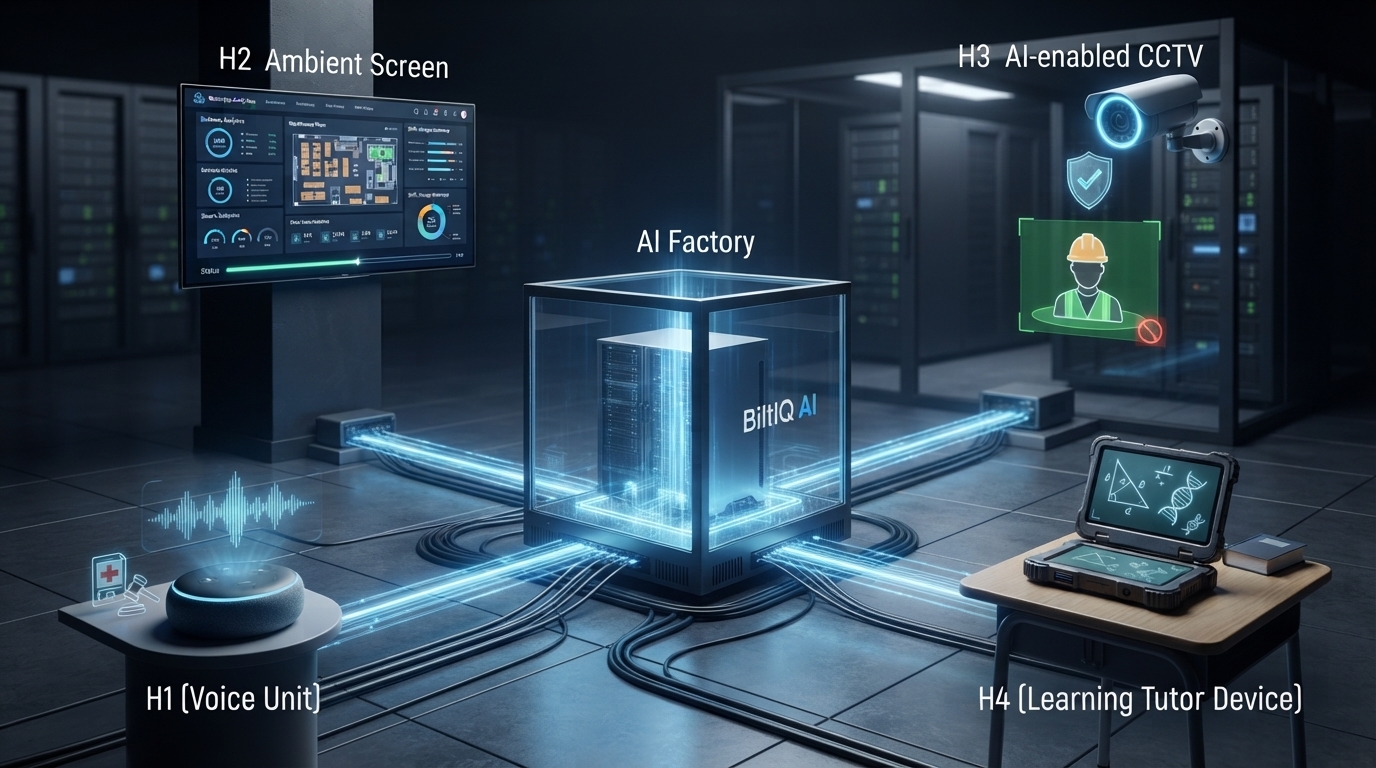
Once an organisation runs its own SI fleet — models, retrieval, agents, and a privacy rail, all inside the building — every new SI device becomes a smaller instance of something already working, rather than a new product with new risks. That is the logic of ambient SI on an on-premises foundation, and this post lays out the roadmap it makes possible: four classes of fixed-function device, each running on the same fleet, behind the same privacy rail. To be clear from the first paragraph: this is a roadmap, published so the trajectory is legible — not a catalogue of shipping products. What ships today is the SI Factory itself; what follows is where a proven stack goes next.
Why the plant comes before the appliance
The consumer-device industry has spent a decade demonstrating the failure mode this roadmap avoids. Ship a clever device first — a speaker, a camera, a screen — and privacy becomes something bolted on afterwards: a settings toggle, a policy page, a promise about the cloud on the other end. Every regulated buyer knows how that story reads in an audit.
The SI Factory inverts the sequence. The plant — compute, models, retrieval, privacy filtering, audit — is installed and proven first, inside the building. A device, in this architecture, is not a product with its own cloud; it is a fixed-function node on an existing fleet, running the same models behind the same privacy rail as the chat interface staff already use. The device inherits sovereignty from the plant, by construction.
That single inversion changes what is buildable. Devices that are commercially impossible as cloud products — because regulated buyers can't accept the data path — become straightforward as fleet endpoints, because there is no data path to object to.
H1 · The voice unit: a speaker whose transcript goes nowhere
Smart-speaker-class hardware — but the model is in the building. Ask it about your own contracts, stock, or patients, and the answer comes from the fleet's retrieval layer, grounded in your documents. No wake word leaves the site, and no transcript reaches a vendor.
That property answers the exact objection that has kept consumer smart speakers out of every regulated office. The objection was never the microphone — offices are full of microphones. It was where the audio goes afterwards: to whose servers, retained how long, used for what. When the answer becomes "nowhere — the audio is processed on the fleet in this building and the transcript exists only in your own audit trail," a voice interface becomes viable in places it has never been: a hospital ward, a bank branch, a law firm's file room.
H2 · The ambient screen: intelligence you walk past
A wall display that answers — and volunteers. What changed today, what needs a decision, what the incoming shift should know. Intelligence you walk past rather than software you remember to open.
Most enterprise software fails on the last step: someone has to open it, remember it exists, form the habit. An ambient screen inverts that failure. The fleet already knows the state of the business — it has ingested the documents, it is connected to the CRM and ERP through the agent layer — so the surface simply shows the current state, continuously, in the corridor where the people who need it walk. No login, no dashboard-fatigue, no adoption curve: the adoption is the placement.
H3 · SI-enabled CCTV: inference where the footage lives
Your existing cameras, with inference running on the site fleet instead of a vendor cloud. Safety adherence, exclusion-zone monitoring, process-sequence verification — the industrial computer-vision use cases with proven value. Retention-limited and consent-gated under DPDP, because footage is the most sensitive data a building holds.
Video is the workload that should never have been a cloud product in the first place: continuous, biometric by nature, and squarely covered by India's DPDP Act. Streaming a facility's cameras to a vendor's cloud creates a permanent, growing liability; processing them on the site fleet creates none, because the footage never leaves the building that generated it. Consent gating and retention limits become configuration of the fleet's existing privacy rail — compliance as architecture, applied to pixels instead of documents.
H4 · The learning tutor device: education with no account and no phone
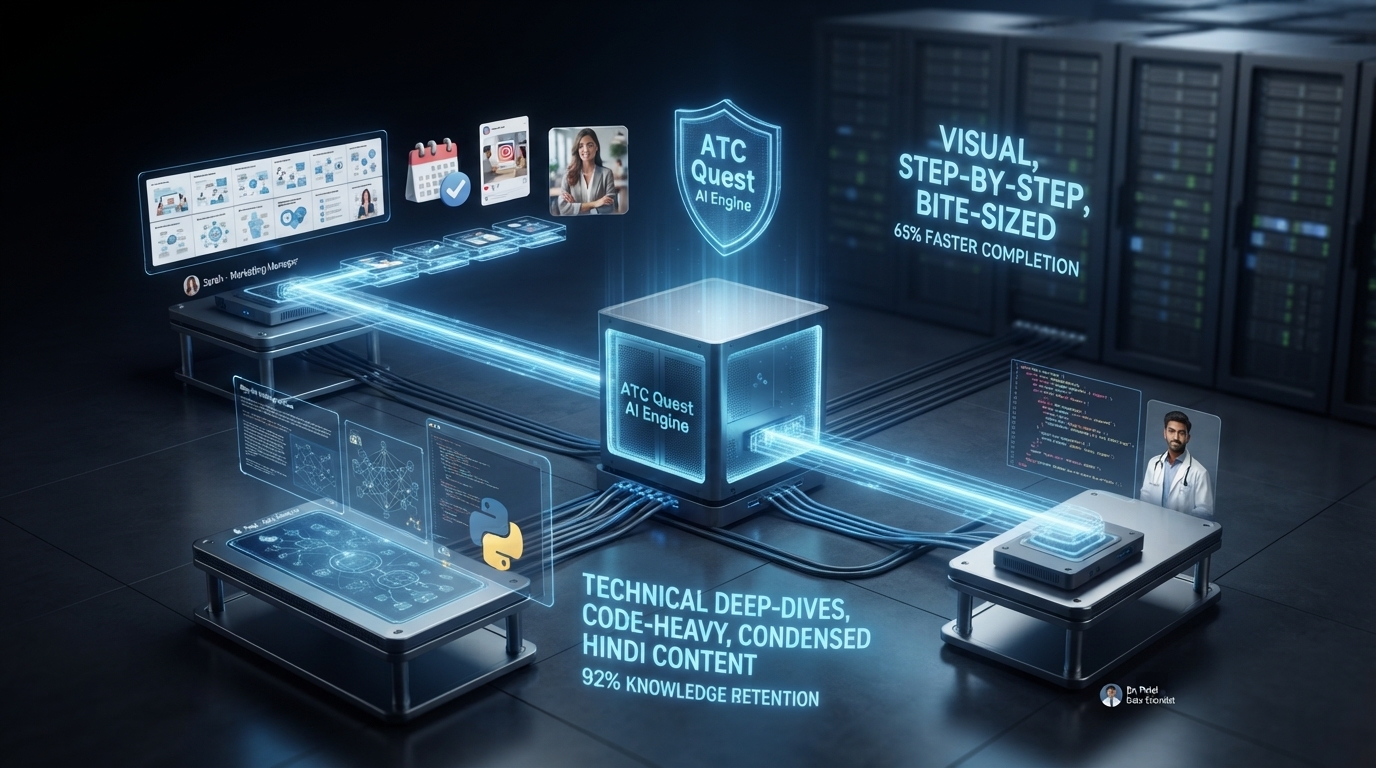
A desk unit running a subject-grounded tutor — no account, no phone — for classrooms, shop floors, and training rooms. It shares the ATC Quest courseware stack, BiltIQ's learning platform already in production with paying customers, so the hardest problem for any tutor device — the content — is already solved.
An offline tutor sidesteps the two hardest problems in educational technology simultaneously. Connectivity: the device works where the internet doesn't, which in India is precisely where educational intervention matters most. And child data: a device with no account, no phone, and no cloud has nothing to sign up for and nothing to leak — child-data protection by the absence of collection rather than by policy governing it.
One principle under all four: the sizing rule doesn't change
The SI Factory's sizing principle — fleets sized to concurrency, growth by adding nodes, never a fixed bill of materials — carries over to devices unchanged. One unit in one room is an edge module; the same software serving a plant or a campus runs on the site fleet or on rented GPU. Same models, same retrieval, same audit trail — different-sized boxes. There is no separate "device platform" to build, secure, and certify; there is one platform, already certified against ISO/IEC 27001:2022, wearing different enclosures.
This is why the roadmap is credible without being counted: each unit is a smaller instance of something already working, not a new company hiding inside a product slide.
How to read a roadmap like this (including ours)
A roadmap post should teach the reader how to evaluate it, so here is the standard we'd apply to any vendor showing ambient-SI concepts, applied to ourselves. Ask what's shipping versus what's projected: shipping today is the SI Factory — the fleet, Manthan retrieval, Agent OS, the privacy rail — plus ATC Quest in production; H1–H4 are roadmap. Ask what the devices inherit versus what must be built new: here, the models, retrieval, privacy rail, and audit chain are inherited from the proven stack; the new work is enclosures, sensors, and per-form-factor integration. Ask what the privacy claim rests on: for these units, it rests on the same architectural fact as the factory itself — processing on premises, deny-by-default egress — not on a new promise invented for the device.
An organisation deploying the SI Factory today isn't buying this roadmap; it's buying the plant. But the plant is the reason the roadmap is short: the distance from "SI in the server closet" to "SI on the wall" is an enclosure, not an architecture.
Nobody else gets smarter on your data — not even the speaker on the shelf.
The BiltIQ SI Factory: enterprise SI on your premises today — and the platform ambient intelligence runs on next. Book a consultation: [email protected] · +91 89868 60088 · www.biltiq.ai
Frequently asked questions
Are these ambient SI devices available to buy today?
No — H1 through H4 are a published roadmap, shown so the trajectory of the platform is legible, not a shipping catalogue. What is deployed and in production today is the SI Factory itself (fleet, retrieval, agents, privacy rail) and the ATC Quest learning platform, which the tutor-device concept builds on.
How can a voice assistant work without sending audio to the cloud?
Speech recognition and the language model both run on the on-premises fleet — the fleet's multimodal nodes handle streaming ASR locally — so no wake word leaves the site and no transcript reaches any vendor. The transcript exists only in the organisation's own tamper-evident audit trail.
Why does on-premises processing matter specifically for CCTV?
Camera footage is continuous, biometric, and regulated under India's DPDP Act, which makes streaming it to a vendor cloud a permanent and growing liability. Running inference on the site fleet means footage never leaves the building, with consent gating and retention limits enforced by the same privacy rail that governs every other model call.
What makes an offline tutor device different from edtech apps?
It has no account, no phone requirement, and no cloud — which means it works without connectivity and collects no child data at all, protecting by absence of collection rather than by policy. The subject content comes from the ATC Quest courseware stack, which is already in production.
Do these devices require new infrastructure beyond the SI Factory?
No — each unit is a fixed-function node on the existing fleet, running the same models behind the same privacy rail; a single unit in one room is an edge module, and larger coverage runs on the site fleet or rented GPU. There is no separate device platform to secure or certify.
Does deploying the SI Factory today commit an organisation to this roadmap?
No — the SI Factory is a complete product on its own: enterprise chat, retrieval, agents, and audit over your own documents. The roadmap describes what additionally becomes easy once that plant exists, precisely because each device is a smaller instance of the stack already running.