

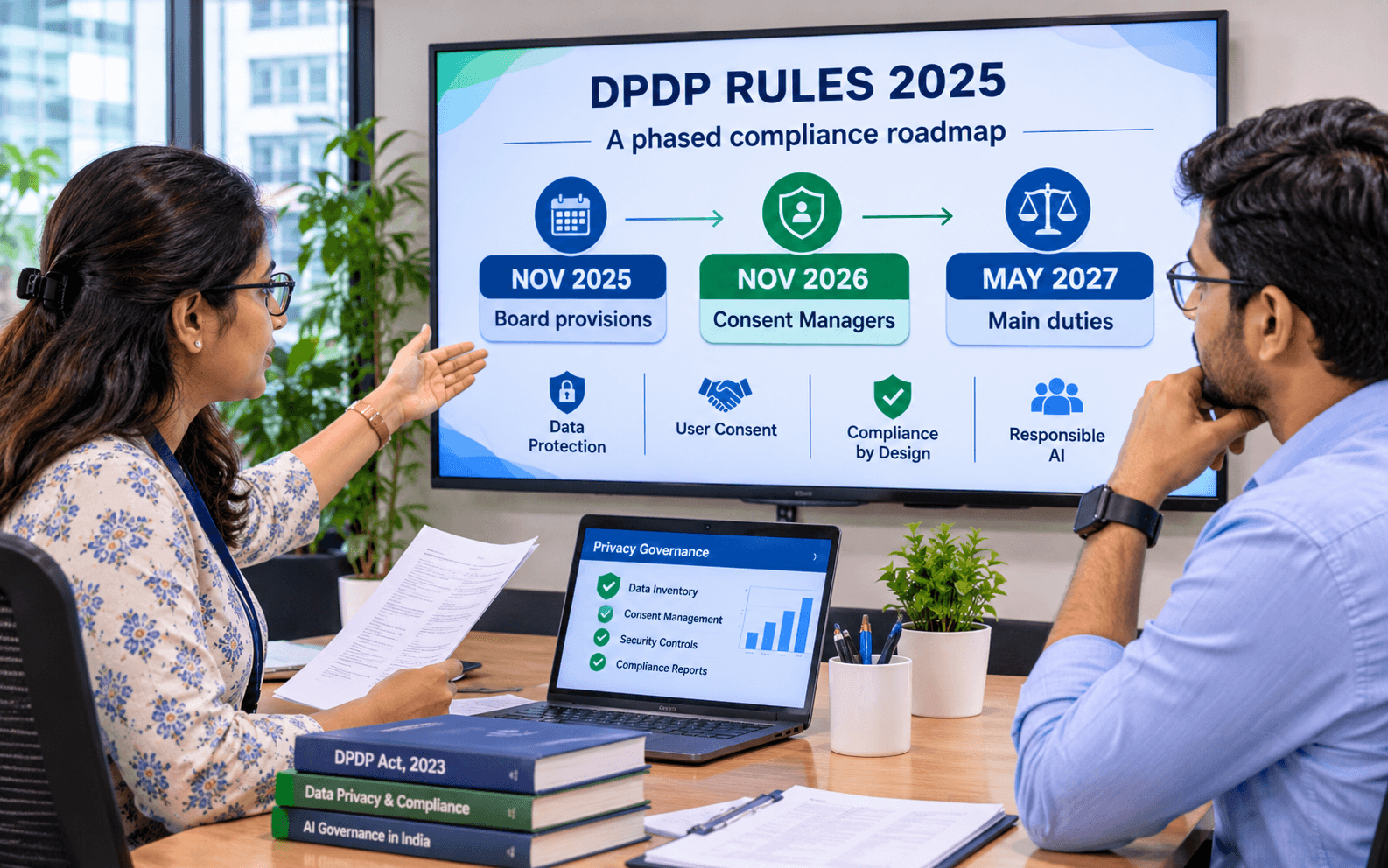
The DPDP Rules 2025 were notified on 13 November 2025 and bring the DPDP Act 2023 into force in three phases: the Data Protection Board provisions at once, consent managers after 12 months (13 November 2026), and the main duties on notice, consent, safeguards, breach reporting, retention and children's data after 18 months (13 May 2027). For a business using AI, the 18-month date is the one to plan against.
At a glance
| Phase | Date | What applies | What it means for AI |
|---|---|---|---|
| 1 | 13/14 Nov 2025 | Rules 1, 2 and 17–21: definitions and the Data Protection Board | The regulator exists; nothing yet to file |
| 2 | 13 Nov 2026 | Rule 4: registration and obligations of consent managers | If you take consent through a consent manager, it must be a registered one |
| 3 | 13 May 2027 | Rules 3, 5–16, 22, 23: notice, consent, security safeguards, breach intimation, retention and erasure, children, significant data fiduciaries, rights, transfers | Every AI system that touches personal data must have its notice, consent basis, safeguards, logs, retention and breach process in place |
| Penalties | Under the Act's Schedule | Up to ₹250 crore for failing to take reasonable security safeguards | The largest penalty is about safeguards, which is where an AI system sits |
Phase 2 takes effect on 13 November 2026 and phase 3 six months after it.
Why does the timeline matter for AI more than for a website form?
A website form collects a name once. An AI system reads documents full of other people's personal data, keeps embeddings of them, logs the prompts, and sometimes sends text to a cloud model. Every one of those is "processing". The Act does not ban it; it asks you to show purpose, consent or a listed legitimate use, safeguards, retention and a breach process. The Rules put dates on each.
What should be done by each date?
| By | Do |
|---|---|
| Now | Inventory every AI tool that touches personal data, including the ones staff use on their own (the live post on shadow AI explains why that list is longer than you think) |
| Now | Decide where inference runs. On an Own-it install no cloud model provider sits in the model path, which shortens the processor list |
| 13 Nov 2026 | If consent is collected through a consent manager, confirm it is registered under rule 4 |
| Before 13 May 2027 | Notices for each purpose the AI serves; the consent or legitimate-use basis recorded |
| Before 13 May 2027 | Reasonable security safeguards in writing, including for processors (rule 6); the Agent OS security gate and approval records are evidence here, not the whole answer |
| Before 13 May 2027 | A breach process: who tells the Board and affected people, in the form the Rules set (rule 7) |
| Before 13 May 2027 | Retention and erasure rules for prompts, embeddings and logs, and the one-year minimum for keeping processing logs |
| Before 13 May 2027 | For children's data: verifiable parental consent and no tracking (the post "DPDP and children's data: a school's checklist before buying AI") |
| If notified as a significant data fiduciary | A DPO based in India, an independent data auditor, periodic impact assessments and audits (rule 13) |
What does owning the AI change, and what does it not?
- Changes: no cloud model provider in the model path; the files the AI reads stay on your server; outbound calls blocked by default in Agent OS; approval records for consequential actions; Business OS writes every copilot call to an append-only log; biltiq-privacy pseudonymises Aadhaar and PAN where you set it.
- Does not change: notices and consent, rights requests, retention, breach reporting and processor contracts stay the business's duty, whichever vendor runs the AI. On-premise AI does not make you compliant; it reduces what you must account for.
- Disclosed: Business OS files are in cloud storage today; Learning OS has cloud parts; the Subscribe tier publishes its data terms at launch.
Does the Act require data to stay in India?
Not in general. The Act lets the government restrict transfers to notified countries; the Rules let it require significant data fiduciaries to keep certain data in India and set conditions on making data available to a foreign state. Sector rules (RBI, SEBI, IRDAI) can be stricter. On an Own-it Agent OS install the files stay on your server whatever the rule.
Glossary: the terms the Rules use
| Term | Meaning |
|---|---|
| Data principal | The person the personal data is about |
| Data fiduciary | The organisation that decides why and how it is processed: you, for your customers' and employees' data |
| Data processor | An organisation processing on your behalf under contract, including an AI vendor that runs a pilot on its servers |
| Significant data fiduciary | A fiduciary the government notifies as such, with extra duties: a DPO in India, an independent auditor, periodic impact assessments |
| Consent manager | A registered platform through which a person gives, manages and withdraws consent (rule 4, from 13 Nov 2026) |
| Data Protection Board | The adjudicating body under the Act |
A 90-day plan for a business that uses AI
| Days | Do |
|---|---|
| 1–15 | Inventory every AI tool that touches personal data, sanctioned or not. Decide where inference runs for each |
| 16–30 | Write the notice for each purpose the AI serves; record the consent or legitimate-use basis |
| 31–60 | Put safeguards in writing, including for processors; sign processor contracts with erasure terms; set log retention to at least the one-year minimum |
| 61–75 | Write the breach process: who tells the Board and affected people, in the form the Rules set |
| 76–90 | If you process children's data, build verifiable parental consent; if you may be a significant data fiduciary, start the DPO and auditor appointments |
The plan fits inside the 18-month phase with time to spare; the point of starting now is that the hardest items, consent for children and the DPO, take the longest.
When should you NOT wait for May 2027?
- You process children's data. Schools and edtech should be ready earlier; the consent mechanism takes time to build.
- You are likely to be a significant data fiduciary. The DPO and auditor take months to appoint.
- A regulator already asks. RBI's FREE-AI report recommends a board-approved AI policy now (the post "RBI's FREE-AI framework: what banks should check before buying AI").
- Staff already use AI tools. Shadow use is processing today, with no notice and no consent.
Frequently asked questions
When do the DPDP Act's main duties apply?
In phases under the DPDP Rules 2025: Board provisions from Nov 2025, consent managers from 13 Nov 2026, and the main operational duties from 13 May 2027. The Act sets penalties for breaches.
Does on-premise AI make us DPDP compliant?
No. It reduces what you must account for, because no cloud model provider sits in the model path. Consent, notices, rights requests, retention and breach reporting stay your duty.
Is BiltIQ a data processor?
Where BiltIQ processes personal data for you, for example in a pilot on its servers or when it runs Learning OS for a school, it acts as your data processor under the contract. You remain the data fiduciary.
Related: What an AI audit trail must record under the DPDP Act · DPDP and children's data: a school's checklist before buying AI · RBI's FREE-AI framework: what banks should check before buying AI · AI usage policy template for a 100–500 person Indian company · DPDP-compliant AI vendor checklist for BFSI and healthcare buyers · What your DPO will ask about your AI vendor · Shadow AI: your staff are already pasting your IP into chatbots
Next step: BiltIQ's DPDP guide on DPDP compliance; a scoping call on contact. Not legal advice.
Facts checked against the BiltIQ product pages, 5 November 2026.