

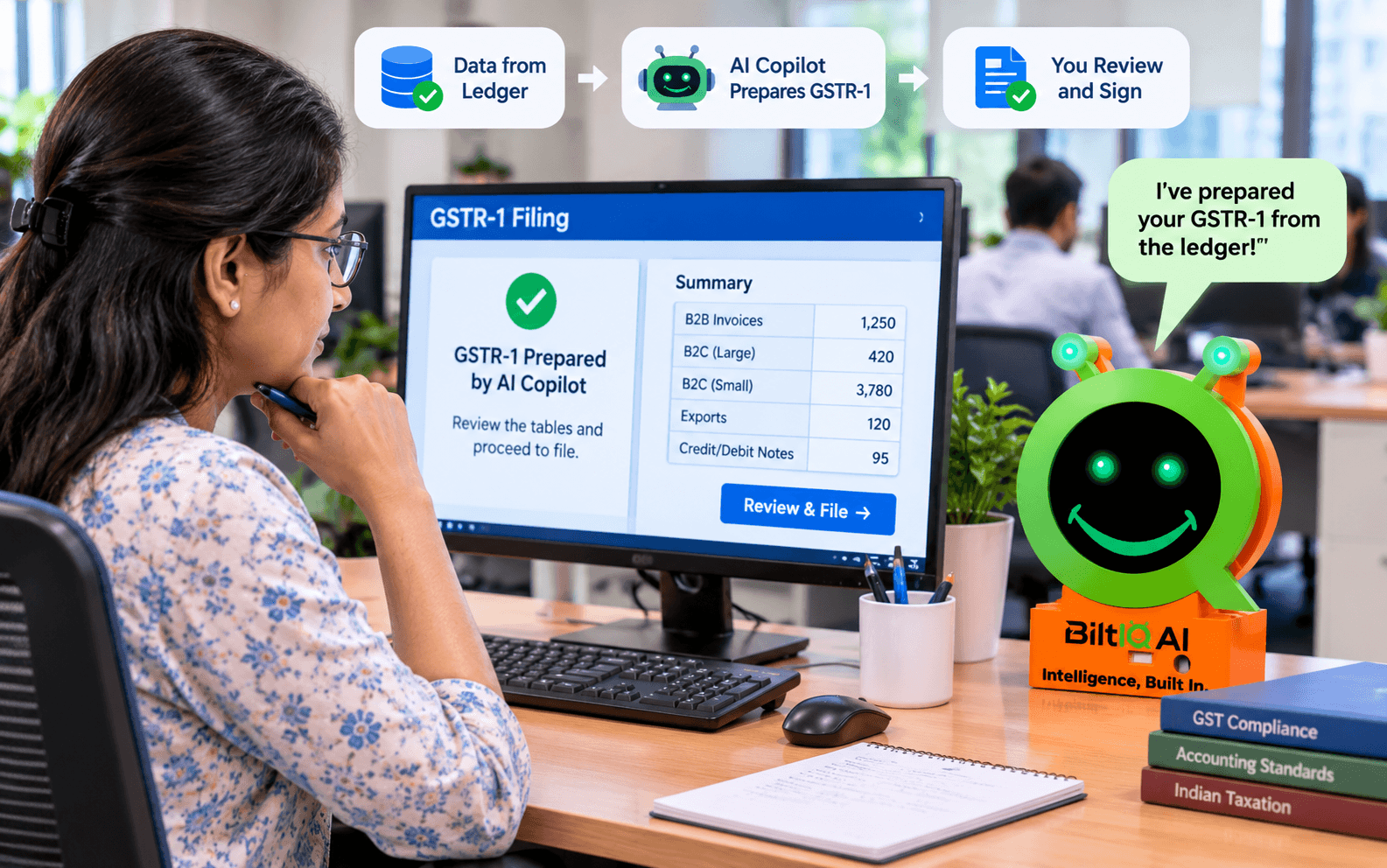
AI GSTR-1 automation means the system prepares the return from invoices already in the ledger, and the accountant checks the tables and files. In BiltIQ Business OS, GST with GSTR-1 export is built. Nothing is filed by the software; IRN e-invoicing and the e-way bill API are on the roadmap, so e-way bills are typed by hand today.
At a glance
| Point | Detail |
|---|---|
| Built today | Double-entry accounts, GST with GSTR-1 export, TDS register and certificates |
| Who files | Your accountant, on the GST portal, after reviewing the export |
| Roadmap, not built | IRN e-invoice; e-way bill API (typed by hand today); TDS codes under the new Income-tax Act |
| Where the ledger sits (Own it) | Database and models on your network; attachments in cloud storage today |
| Deadline it serves | GSTR-1 is due monthly (the 11th of the following month) or quarterly under QRMP |
What goes into a GSTR-1?
GSTR-1 is the statement of outward supplies. The tables that take the work are the same for every business:
| Table | What it holds | Where the errors come from |
|---|---|---|
| 4 | B2B invoices to registered buyers | Wrong GSTIN, wrong place of supply |
| 5 | Large inter-state B2C invoices | Invoices above the threshold left in the B2C summary |
| 6 | Exports and SEZ supplies | Missing shipping bill details |
| 7 | B2C others, summarised by state and rate | Rate mismatches |
| 9 | Amendments to earlier periods | Credit and debit notes not linked to the original invoice |
| 11 | Advances received and adjusted | Advances invoiced twice |
| 12 | HSN-wise summary | Missing or short HSN codes |
| 13 | Documents issued | Cancelled invoice series not reported |
When sales are entered in one place and GST is prepared in another, these tables are rebuilt by hand every month. That is the job an AI ERP takes away.
What does the copilot prepare?
Because Business OS posts sales to the ledger as they happen, the GSTR-1 export is built from entries that already exist. The copilot's part is reading and drafting:
- Invoices, credit notes and debit notes land in the ledger from the sales flow (quote, order, invoice, credit note), so the B2B and B2C split follows the customer master.
- Rate and HSN come from the item master, not from re-typing at month end.
- Amendments are drafted against the original document.
- The export is prepared for your filing workflow. The accountant opens it, checks it and files.
What the export looks like and which checks run before it is produced are confirmed on the scoping call.
What does the accountant still sign?
Statutory accountability cannot be delegated to software, and Business OS is built around that:
| Step | Who | What they check |
|---|---|---|
| Exceptions | Accountant | Anything the ledger could not place: unregistered buyers with large invoices, rate changes mid-month, documents without HSN |
| Totals | Accountant | Outward supply totals against the ledger, so nothing is counted twice or left out |
| Filing | Accountant | Uploads and files on the GST portal. Business OS does not file |
Any copilot tool that changes data waits for approval. A GSTR-1 export is prepared from approved entries; it does not create them.
What is built, and what is roadmap?
| Capability | Status |
|---|---|
| Sales flow: quotes, orders, invoices, credit notes | Built |
| Double-entry ledger, bank reconciliation | Built |
| GST with GSTR-1 export | Built |
| TDS register and certificates | Built |
| IRN e-invoice | Roadmap |
| E-way bill API | Roadmap (typed by hand today) |
| TDS codes under the new Income-tax Act | Roadmap |
| Direct Tally or Zoho importer | Roadmap (Excel/CSV import today) |
What does month-end look like when the ledger has done the work?
Illustrative, for a trading firm filing monthly.
| When | What happens | Who |
|---|---|---|
| During the month | Quotes become orders, orders become invoices, invoices post to the ledger as they are raised. Credit notes are drafted against the original invoice | The copilot proposes, a person approves |
| 1st of the next month | The GSTR-1 export is prepared from the ledger. An exceptions list sits beside it: invoices without an HSN, a buyer whose GSTIN failed its format check, an inter-state B2C invoice above the threshold | System |
| 2nd to 8th | The accountant works the exceptions, checks table totals against the ledger, and confirms amendments to earlier periods | Accountant |
| By the 11th | The accountant files on the GST portal. Business OS does not file | Accountant |
Under QRMP the same export is prepared for the quarter, with the invoice furnishing facility handled by the accountant as today.
The difference from a spreadsheet month-end is not speed on the day. It is that the tables are built from entries a person already approved, so the review is a check, not a rebuild.
What should you confirm on the scoping call?
The 30-minute scoping call ends with a written next step. For GSTR-1 the questions worth settling there:
- Export format. Which format your accountant or CA uses for upload, and whether the export matches it as built or needs a mapping.
- Masters. How rate and HSN are set per item, and who maintains them when a rate changes.
- Amendments. How credit notes, debit notes and amendments to earlier periods are linked to the original document.
- More than one GSTIN. Whether your firm files under several registrations and how each is separated.
- TDS. How the TDS register and certificates sit beside the GST work.
- Checks. Which validations run before the export is produced, and which exceptions the accountant will see.
Put the answers in the written phase-1 plan. A return is a statutory document; the division of work between the system and the accountant should be in writing before the first month runs.
When should you NOT automate GSTR-1?
- No accountant reviews the export. The export is a draft of a statutory return; a person has to own it.
- You need IRN e-invoicing or e-way bill generation from the same screen today. Both are roadmap.
- Your sales do not pass through the system. If invoices are raised elsewhere and only summarised later, the export will be as incomplete as the ledger.
- You expect the software to file. It will not. Filing stays with the accountant on the portal.
One misreading to avoid
"GSTR-1 automation" is often read as "the software files my return". It does not, and no vendor should. The automation is upstream of the return: invoices posted once, masters kept clean, amendments linked, exceptions surfaced early. The statutory act of filing stays with the accountant, with their login and their accountability. If a demo shows a button that files, ask who is liable when it files the wrong figure.
Frequently asked questions
Does Business OS file GSTR-1 on the GST portal?
No. It prepares the GSTR-1 export from the ledger. The accountant reviews it and files on the portal.
Can it generate e-invoices (IRN) or e-way bills?
Not yet. IRN e-invoicing and the e-way bill API are on the roadmap; e-way bills are typed by hand today. BiltIQ states this up front so you can plan the gap.
Where does our GST data sit?
On an Own-it install, the database and the AI models run on your network. Attachments and documents are stored in cloud storage today; on-prem file storage is a roadmap item. For India, BiltIQ refers to the DPDP Act 2023.
Related: AI ERP for Indian SMEs: what runs alone, what waits for a human · AI ERP cost in India in 2026: subscribe or own it? · Human-in-the-loop AI agents: which actions should need approval?
Next step: Business OS for what is built; book a scoping call on contact.
Facts checked against the BiltIQ product pages, 5 November 2026.